Accounts Receivable Recovery Kit
Rank which unpaid invoices to chase first — by amount, age, and risk — and get three emails that actually collect. The fastest cash you'll raise this quarter is the cash you've already earned.
TL;DR
Most businesses chase invoices in random order — oldest, loudest, or whoever they remember. This kit fixes the order. In the example, six invoices totaling $33,200 surface $19,800 of chase-now money to recover this week and flag $6,200 for write-off review.
instant download · .xlsx · 30-day guarantee
The problem
Unpaid invoices aren't a sales problem. They're money in someone else's account.
Most small businesses sit on a pile of overdue invoices and chase them in random order — oldest, loudest, or whoever comes to mind. The oldest is usually the least collectable, so the effort goes to the wrong place.
Rank by recoverable amount, age, and risk together, and the highest-leverage half hour appears: the chase-now balances most likely to come in with one firm follow-up. Start there, top down by amount.
total outstanding across the example's six invoices
chase-now money recoverable this week
flagged for write-off review — stop chasing it
reminder, firm follow-up, final notice — ready to send
Example figures are computed live from the workbook's seeded sample invoices — not a claim about any real business.
What's inside
One sheet ranks who to chase — plus three emails that collect.
One .xlsx — open it in Excel, Google Sheets, or Numbers and build your chase list today.
Invoices tab
List your open invoices: number, customer, amount, due date, days overdue, and customer risk. The sheet sorts each into Current, Remind, Chase now, or Write-off review — example data filled in, ready to overwrite.
Receivables Dashboard
Total outstanding, the exact chase-now money you can recover this week, the balance flagged for write-off review, and the count in each recovery bucket — your highest-leverage 30 minutes, made obvious.
Three chase emails
A gentle reminder, a firm follow-up, and a final notice — courteous, specific, and ready to send. Copy, fill the brackets, send. Courtesy collects faster than threats and keeps the relationship intact.
The recovery-action model
A transparent, editable rule that ranks by amount, age, and risk together — so you start with the money most likely to come in, not the invoice that happens to be oldest.
How the ranking works
Amount, age, and risk — then the action
Each open invoice is sorted by how overdue it is, how large it is, and how risky the customer is to collect from:
- Chase now — over 30 days late, or ≥$5,000 and over a week late — your recovery priority
- Remind — recently overdue and modest — a friendly nudge usually does it
- Write-off review — 120+ days (or old and high-risk) — decide whether to escalate or write off
- Current — not yet overdue — nothing to do but watch the due date
The built-in example · 6 invoices
A vague anxiety becomes a 30-minute task: three firm follow-ups, top down by amount.
Try it
Rank which invoices to chase first
Total outstanding
$33,200
Chase-now money (this week)
$19,800
Flagged for write-off review
$6,200
Current / Remind / Chase / W-off
0 / 2 / 3 / 1
This is the live engine. Your numbers here reset when you reload. The kit saves your full invoice list, shows the exact chase-now total to recover this week, and includes three escalating, courteous emails — a reminder, a firm follow-up, and a final notice.
Get the kit — $39| Invoice # | Customer | Amount | Days late | Risk | Action |
|---|---|---|---|---|---|
| Remind | |||||
| Chase now | |||||
| Chase now | |||||
| Write-off review | |||||
| Remind | |||||
| Chase now |
Days overdue is your input. The action is a prioritization guide, not legal or collections advice — escalation, late fees, and write-offs are your call.
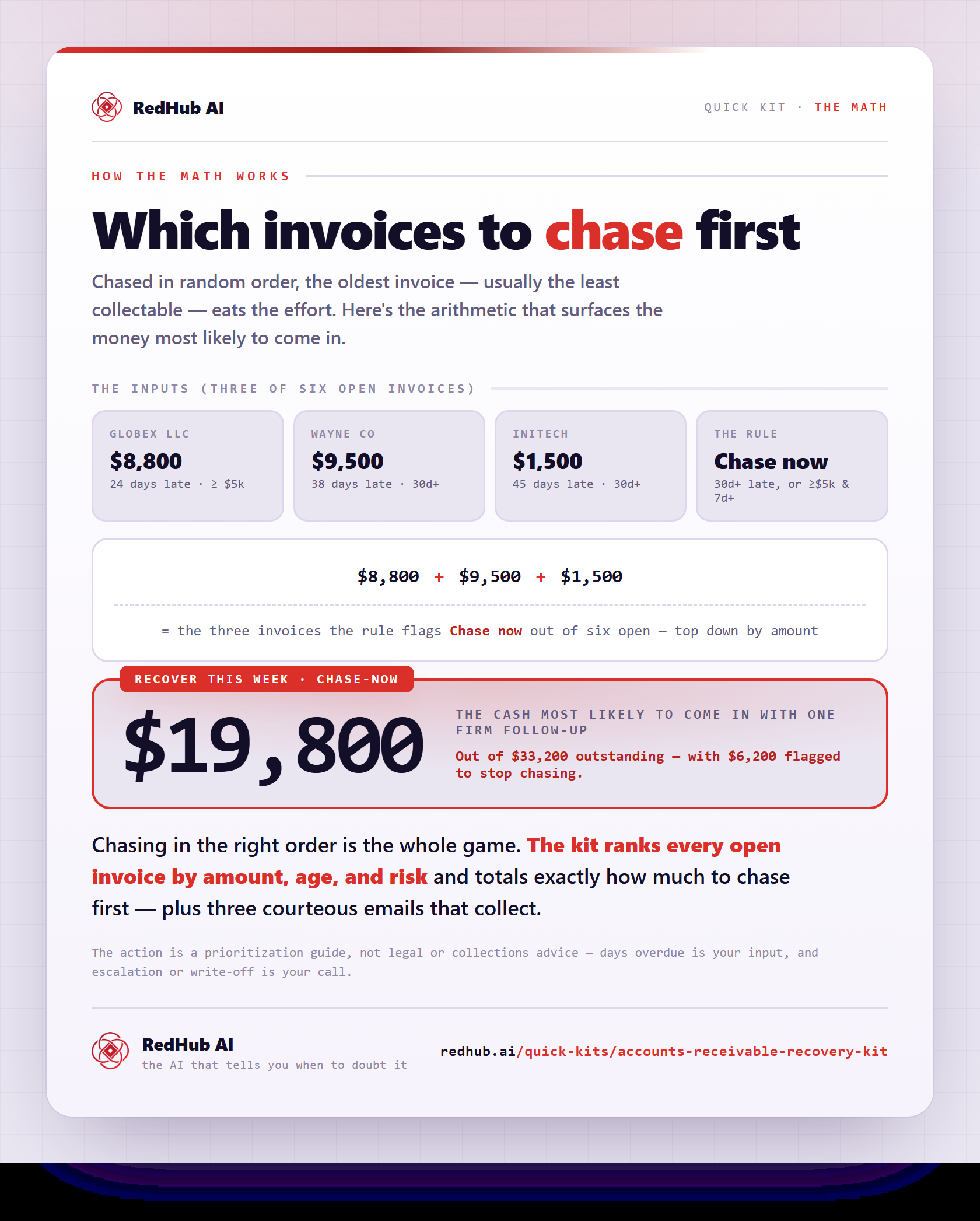
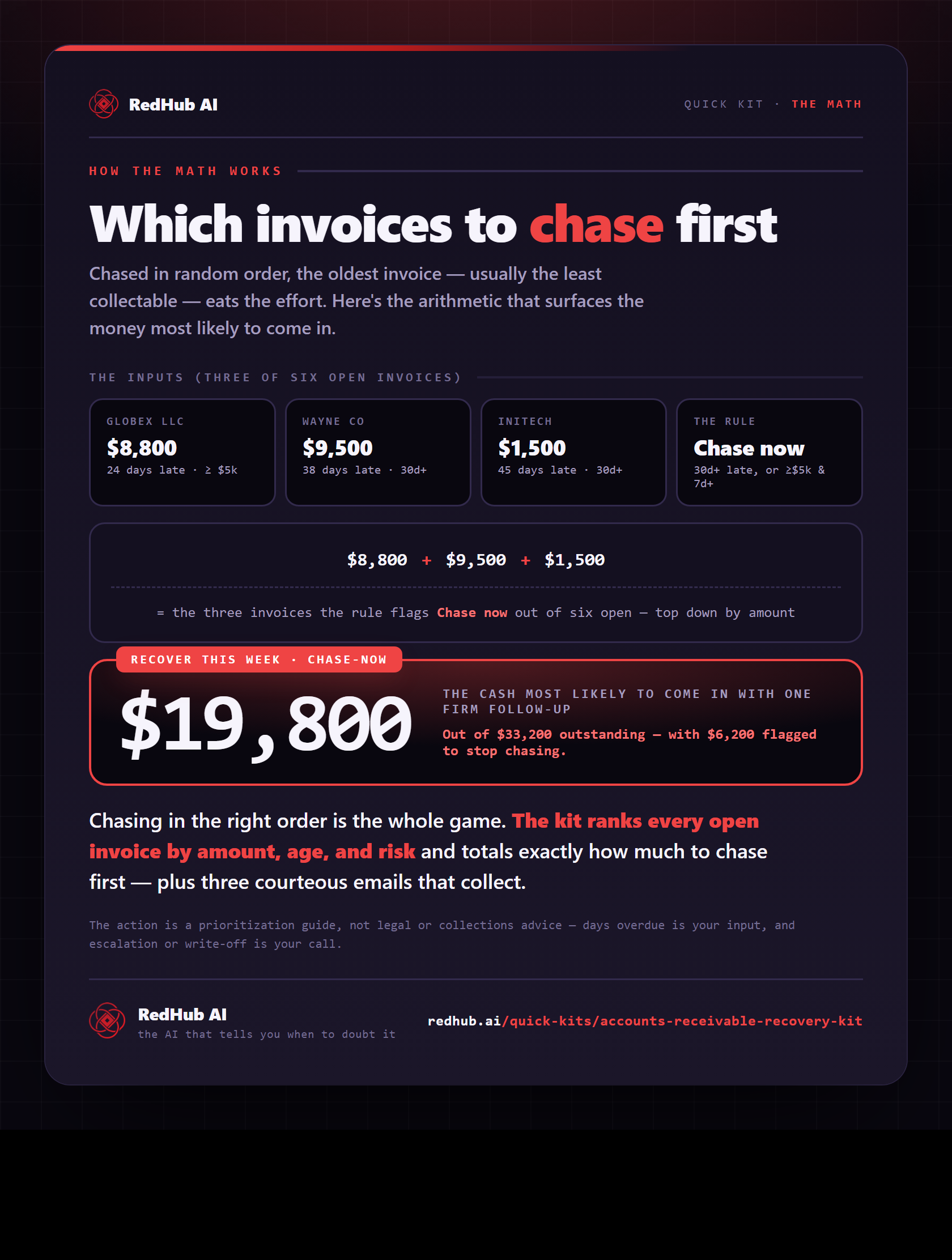
The math behind it, in one image
See how the kit ranks invoices by amount, age, and risk — three Chase-now invoices surface $19,800 recoverable this week out of $33,200 open.
See the full calculationWhy it's different
The right order, and the right words
Ranks by recoverability
Amount, age, and risk together — so your effort goes to the money most likely to come in, not the oldest invoice on the pile.
Courtesy that collects
Three escalating emails that stay polite at every stage. Courtesy collects faster than threats — and protects the relationship for repeat business.
A guide, not advice
The action is a prioritization guide, not legal or collections advice. Escalation, late fees, and write-offs are your call.
Chasing in the right order is the whole game. Most people start with the oldest invoice — usually the least collectable one.
Who it's for
Clear about the lane. No inflated promises.
Built for you if…
- You invoice customers and carry a pile of unpaid or overdue balances
- You're a small business, agency, freelancer, or services firm doing your own collections
- You want to chase in the right order and stop wasting time on what won't pay
- You'd rather send a courteous, effective email than write one from scratch
Not for you if…
- You want a live integration that syncs invoices from your accounting software
- You need a collections agency or legal escalation, not a prioritization tool
- You don't track amount or days overdue per invoice even roughly
Pairs well with
Collect what’s owed, then plug the other leaks.
Recovering receivables is one cash lever; find the rest. The Profit Leak Finder flags the accounts that cost more than they pay, the Inventory Cash-Trap Finder frees the cash stuck in dead stock, and the AI SaaS Subscription Auditor cuts the subscriptions quietly draining it.
Common Questions
The questions owners actually ask before they start chasing.
It's a one-time spreadsheet that turns a pile of unpaid invoices into a ranked chase list. You enter each open invoice's amount, days overdue, and customer risk; it sorts every one into Current, Remind, Chase now, or Write-off review, shows the chase-now money you can recover this week, and includes three escalating, courteous dunning emails.
One .xlsx with four tabs (including the Chase Emails) that opens in Microsoft Excel, Google Sheets, or Apple Numbers — no subscription, no login. It ships with a worked example so it makes sense immediately; overwrite it with your own invoices.
By amount, age, and risk together. Anything over 30 days late — or a large balance (≥$5,000) over a week late — becomes Chase now. Very old invoices (120+ days, or 90+ and high-risk) go to Write-off review. Recent, modest overdue balances get a gentle Remind. Not-yet-due invoices stay Current.
Because the oldest is usually the least collectable. Chasing in the right order — by recoverable amount and age, not just whoever's oldest or loudest — is the whole game. In the built-in example, six invoices totaling $33,200 surface $19,800 of chase-now money and flag $6,200 for write-off review, so you stop wasting time on what won't pay.
A gentle reminder (for Remind), a firm follow-up (for Chase now), and a final notice (for Write-off review, before escalating). They're courteous and specific by design — courtesy collects faster than threats and protects the relationship for repeat business. Fill the brackets, send.
No. The verdict is a prioritization guide, not legal or collections advice. Late fees, escalation, and write-offs are your decision and may carry legal or tax implications worth professional input. Days overdue is something you enter so the sheet stays predictable and matches your records.
Yes — a 30-day money-back guarantee. If it doesn't help you recover cash you're already owed, request a refund within 30 days.
Get the kit
Recover the cash you're already owed.
Instant download, yours to keep, 12 months of updates. Collecting one overdue invoice usually covers it many times over.
- 4-tab .xlsx: Start Here, Invoices, Dashboard, Chase Emails
- Chase-ranking engine + Current / Remind / Chase now / Write-off
- Three courteous, escalating dunning emails — ready to send
- Works in Excel, Google Sheets, or Numbers · 30-day guarantee