Tool Gate · How it works
How the Unit-Cost Basis Freshness Gate gate works
How the Unit-Cost Basis Freshness Gate reads ten trades into one verdict: each trade declares its own freshness horizon of 24, 12 or 6 months, so 19 months reads current on concrete and 17 reads stale on copper, and an escalation trigger fires inside the horizon on a rate nobody has tested. The sample has 63% of exposure current and returns PRICING ON MEMORY.
How the gate works
This tool grades every trade against its OWN freshness horizon, and weighs the answer by the dollars each trade prices. It reads 10 priced trades and rolls them into one verdict — the worst, never the average — and then a gate that can only make it worse.
The 10 priced trades
| Priced trade | Verdict |
|---|---|
| TR-01 · Structural steel · volatile · 4m oldfix first · gated | CURRENT75 · inside its 6m horizon, and never market-tested |
| TR-02 · Cast-in-place concrete · stable · 19m old | CURRENT100 · 19 months, and current — the horizon is 24m here |
| TR-03 · Metal stud and drywall · moving · 8m old | CURRENT83 · inside its 12m horizon |
| TR-04 · Copper rough plumbing · volatile · 17m oldgated | STALE33 · 17 months against a 6m horizon — past twice its clock |
| TR-05 · Roofing membrane · moving · 11m old | CURRENT75 · inside its 12m horizon, just |
| TR-06 · Site earthwork · stable · no date | AGING83 · a blank date caps the trade and fires nothing |
| TR-07 · Electrical rough-in · moving · 26m oldgated | STALE75 · 26 months against a 12m horizon |
| TR-08 · Painting and coatings · stable · 9m old | CURRENT100 · source named, evidence retrievable, owner named |
| TR-09 · Fire protection · moving · 7m old | CURRENT92 · inside its 12m horizon |
| TR-10 · Temporary facilities · stable · 31m old | OUT OF SCOPEdeclared out of scope, and reported |
The verdict bands
Two triggers, and the second fires where the first structurally cannot. Any trade past TWICE its own horizon forces PRICING ON MEMORY — per trade, so 17 months is late on copper and 19 months is current on concrete. The second is the escalation trap: any trade INSIDE its horizon that has never been market-tested. A firm raising every rate 4% each January has a basis dated today and founded on nothing, so every age column reads fresh and an age check is blind to it — which is also exactly how a book stops looking old, so this trigger stands in the first one's escape route.
In the worked sample it reads PRICING ON MEMORY — Six of nine in-scope trades read CURRENT and 63% of priced exposure sits on a current basis. Both triggers still fire. Copper at 17 months and electrical at 26 are each past twice their own clock. And TR-01 reads CURRENT at four months old while never having been checked against anything real — the largest single exposure on the page, invisible to any age column, and the reason the second trigger exists. Marked fix first on this sample: TR-01 Structural steel · market-test it — a gated trade outranks a worse-scoring one, and this one reads fresh.
Common questions
Can every priced trade look survivable on the How the Unit-Cost Basis Freshness gate works and the company still read PRICING ON MEMORY?
Yes. The roll-up takes the worst of 10 priced trades — never the average — then a worsen-only gate, the Freshness gate gate, escalates when trouble clusters. In the worked sample it reads PRICING ON MEMORY because six of nine in-scope trades read CURRENT and 63% of priced exposure sits on a current basis. Both triggers still fire. Copper at 17 months and electrical at 26 are each past twice their own clock. And TR-01 reads CURRENT at four months old while never having been checked against anything real — the largest single exposure on the page, invisible to any age column, and the reason the second trigger exists.
What is a worsen-only gate?
A rule that can only lower a verdict, never raise it. One gate-triggering gap overrides an otherwise-set of survivable lines, because a single gate-triggering gap shouldn't hide behind an average of the healthy ones. Where something is short, the fix-first row names it — here, "TR-01 Structural steel · market-test it — a gated trade outranks a worse-scoring one, and this one reads fresh".
Grades a register of trades you fill in, never a person. It holds no cost data and reaches no published index, reads no estimating system, quote or job cost, never says whether a rate is high or low or what one should be, and forecasts no material price.
Embed this diagram
Free to share and embed with attribution (CC BY 4.0) — keep the link to redhub.ai.
Interactive — renders the live diagram
<iframe src="https://redhub.ai/visuals/tool/unit-cost-basis-freshness-gate.html" title="How the Unit-Cost Basis Freshness Gate gate works — RedHub AI" width="760" height="2643" loading="lazy" style="border:0;width:100%;max-width:760px"></iframe>
<p style="font:14px/1.5 system-ui,sans-serif"><a href="https://redhub.ai/visuals/tool/unit-cost-basis-freshness-gate">How the Unit-Cost Basis Freshness Gate gate works</a> — by <a href="https://redhub.ai">RedHub AI</a>, the AI that tells you when to doubt it.</p>
Image + link — a static picture for any blog
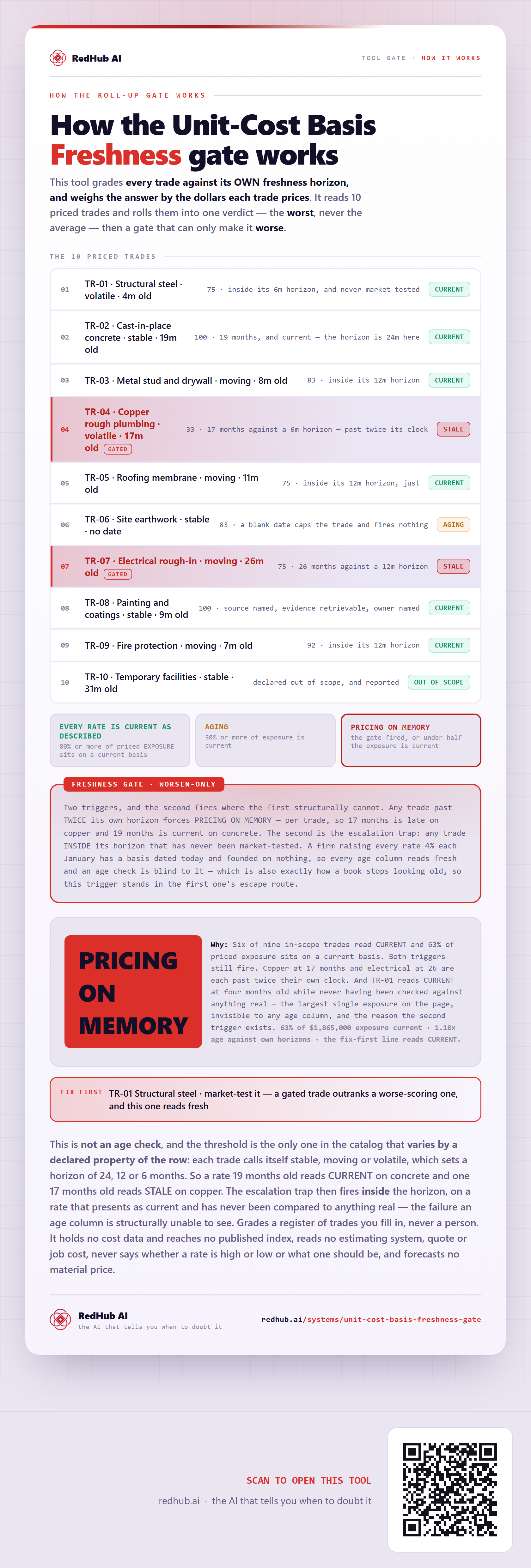
<a href="https://redhub.ai/visuals/tool/unit-cost-basis-freshness-gate"><img src="https://redhub.ai/visuals/tool/unit-cost-basis-freshness-gate-share.png" alt="Diagram of the Unit-Cost Basis Freshness Gate: ten priced construction trades each carrying its own freshness horizon and marked current, aging or stale, two trades gated for being past twice their own horizon, a third that reads current yet is gated and marked fix first because it was never market-tested, a two-trigger freshness gate weighed by priced exposure, and a sample verdict reading PRICING ON MEMORY." width="760" loading="lazy" style="max-width:100%;height:auto;border-radius:16px"></a>
<p style="font:14px/1.5 system-ui,sans-serif"><a href="https://redhub.ai">RedHub AI</a> — the AI that tells you when to doubt it.</p>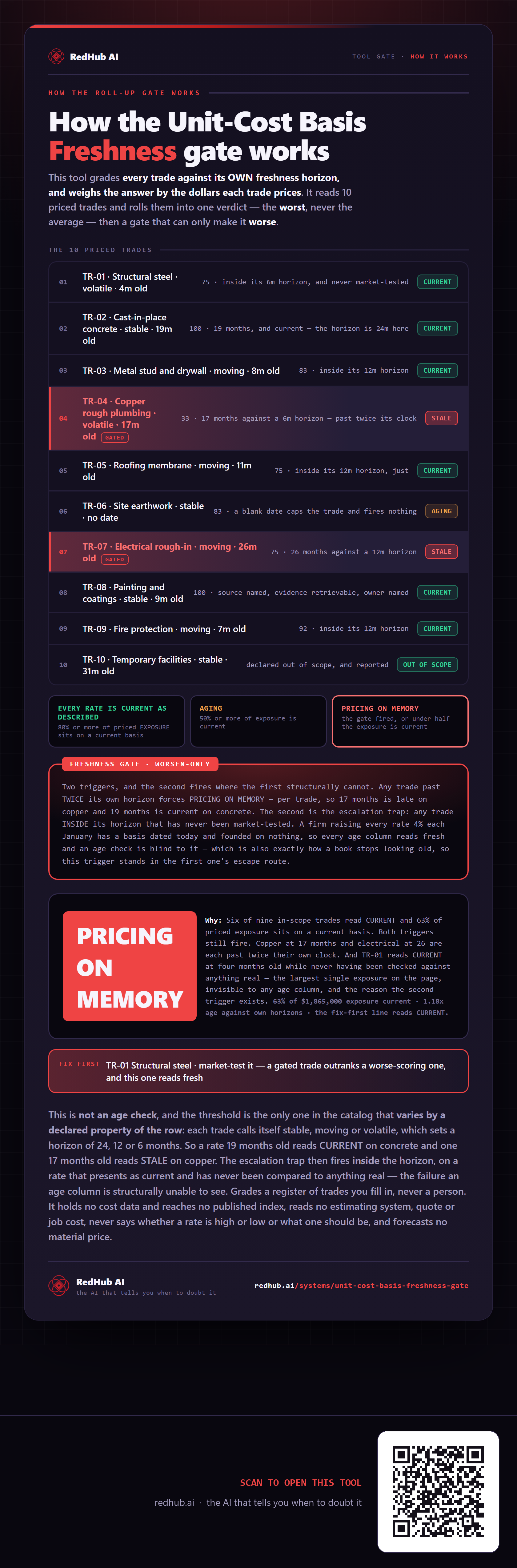
This is how Unit-Cost Basis Freshness Gate works. More diagrams in the Visual Field Guide.