Tool Gate · How it works
How the ISO 42001 AIMS Readiness & Gap Diagnostic gate works
How the ISO 42001 AIMS Readiness & Gap Diagnostic rolls your clause-groups up to the weakest — then a mandatory-clause floor gate escalates the verdict to NOT READY when a required clause-group sits at the floor, so a mature average maturity still isn't certification-ready with one mandatory gap.
How the gate works
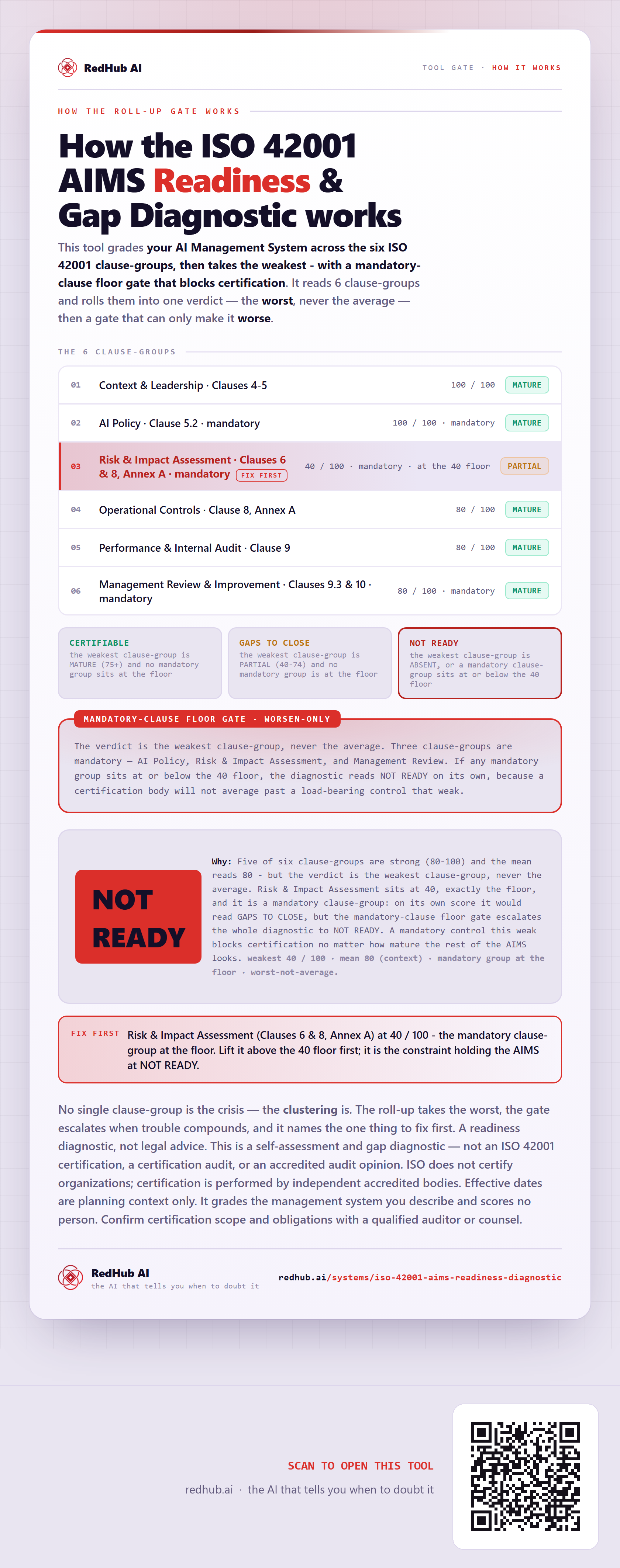
This tool grades your AI Management System across the six ISO 42001 clause-groups, then takes the weakest - with a mandatory-clause floor gate that blocks certification. It reads 6 clause-groups and rolls them into one verdict — the worst, never the average — and then a gate that can only make it worse.
The 6 clause-groups
| Clause-group | Verdict |
|---|---|
| Context & Leadership · Clauses 4-5 | MATURE100 / 100 |
| AI Policy · Clause 5.2 · mandatory | MATURE100 / 100 · mandatory |
| Risk & Impact Assessment · Clauses 6 & 8, Annex A · mandatoryfix first | PARTIAL40 / 100 · mandatory · at the 40 floor |
| Operational Controls · Clause 8, Annex A | MATURE80 / 100 |
| Performance & Internal Audit · Clause 9 | MATURE80 / 100 |
| Management Review & Improvement · Clauses 9.3 & 10 · mandatory | MATURE80 / 100 · mandatory |
The verdict bands
The verdict is the weakest clause-group, never the average. Three clause-groups are mandatory — AI Policy, Risk & Impact Assessment, and Management Review. If any mandatory group sits at or below the 40 floor, the diagnostic reads NOT READY on its own, because a certification body will not average past a load-bearing control that weak.
In the worked sample it reads NOT READY — Five of six clause-groups are strong (80-100) and the mean reads 80 - but the verdict is the weakest clause-group, never the average. Risk & Impact Assessment sits at 40, exactly the floor, and it is a mandatory clause-group: on its own score it would read GAPS TO CLOSE, but the mandatory-clause floor gate escalates the whole diagnostic to NOT READY. A mandatory control this weak blocks certification no matter how mature the rest of the AIMS looks. Marked fix first on this sample: Risk & Impact Assessment (Clauses 6 & 8, Annex A) at 40 / 100 - the mandatory clause-group at the floor. Lift it above the 40 floor first; it is the constraint holding the AIMS at NOT READY..
Common questions
Can every clause-group look survivable on the How the ISO 42001 AIMS Readiness & Gap Diagnostic works and the company still read NOT READY?
Yes. The roll-up takes the worst of 6 clause-groups — never the average — then a worsen-only gate, the Mandatory-clause floor gate gate, escalates when trouble clusters. In the worked sample it reads NOT READY because five of six clause-groups are strong (80-100) and the mean reads 80 - but the verdict is the weakest clause-group, never the average. Risk & Impact Assessment sits at 40, exactly the floor, and it is a mandatory clause-group: on its own score it would read GAPS TO CLOSE, but the mandatory-clause floor gate escalates the whole diagnostic to NOT READY. A mandatory control this weak blocks certification no matter how mature the rest of the AIMS looks.
What is a worsen-only gate?
A dispositive rule that can only lower a verdict, never raise it. One fatal flaw overrides an otherwise-set of survivable lines, because a single disqualifying gap shouldn't hide behind an average of the healthy ones. Where something is short, the fix-first row names it — here, "Risk & Impact Assessment (Clauses 6 & 8, Annex A) at 40 / 100 - the mandatory clause-group at the floor. Lift it above the 40 floor first; it is the constraint holding the AIMS at NOT READY.".
A readiness diagnostic, not legal advice. This is a self-assessment and gap diagnostic — not an ISO 42001 certification, a certification audit, or an accredited audit opinion. ISO does not certify organizations; certification is performed by independent accredited bodies. Effective dates are planning context only. It grades the management system you describe and scores no person. Confirm certification scope and obligations with a qualified auditor or counsel.
Embed this diagram
Free to share and embed with attribution (CC BY 4.0) — keep the link to redhub.ai.
Interactive — renders the live diagram
<iframe src="https://redhub.ai/visuals/tool/iso-42001-aims-readiness-diagnostic.html" title="How the ISO 42001 AIMS Readiness & Gap Diagnostic gate works — RedHub AI" width="760" height="2025" loading="lazy" style="border:0;width:100%;max-width:760px"></iframe>
<p style="font:14px/1.5 system-ui,sans-serif"><a href="https://redhub.ai/visuals/tool/iso-42001-aims-readiness-diagnostic">How the ISO 42001 AIMS Readiness & Gap Diagnostic gate works</a> — by <a href="https://redhub.ai">RedHub AI</a>, the AI that tells you when to doubt it.</p>
Image + link — a static picture for any blog
<a href="https://redhub.ai/visuals/tool/iso-42001-aims-readiness-diagnostic"><img src="https://redhub.ai/visuals/tool/iso-42001-aims-readiness-diagnostic-share.png" alt="Diagram of the ISO 42001 AIMS Readiness & Gap Diagnostic: clause-groups rolled up worst-not-average, a mandatory-clause floor gate, and the AIMS reading NOT READY." width="760" loading="lazy" style="max-width:100%;height:auto;border-radius:16px"></a>
<p style="font:14px/1.5 system-ui,sans-serif"><a href="https://redhub.ai">RedHub AI</a> — the AI that tells you when to doubt it.</p>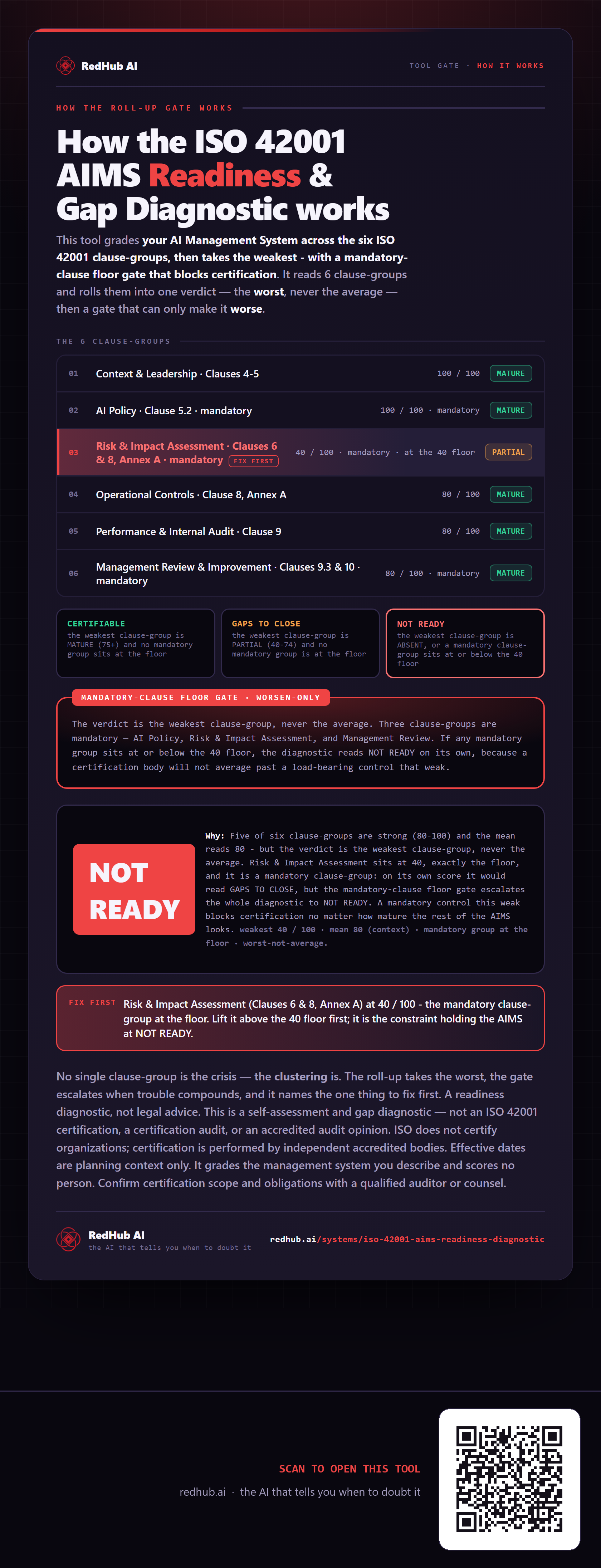
This is how ISO 42001 AIMS Readiness & Gap Diagnostic works. More diagrams in the Visual Field Guide.