Tool Gate · How it works
How the Forecast-Floor gate works
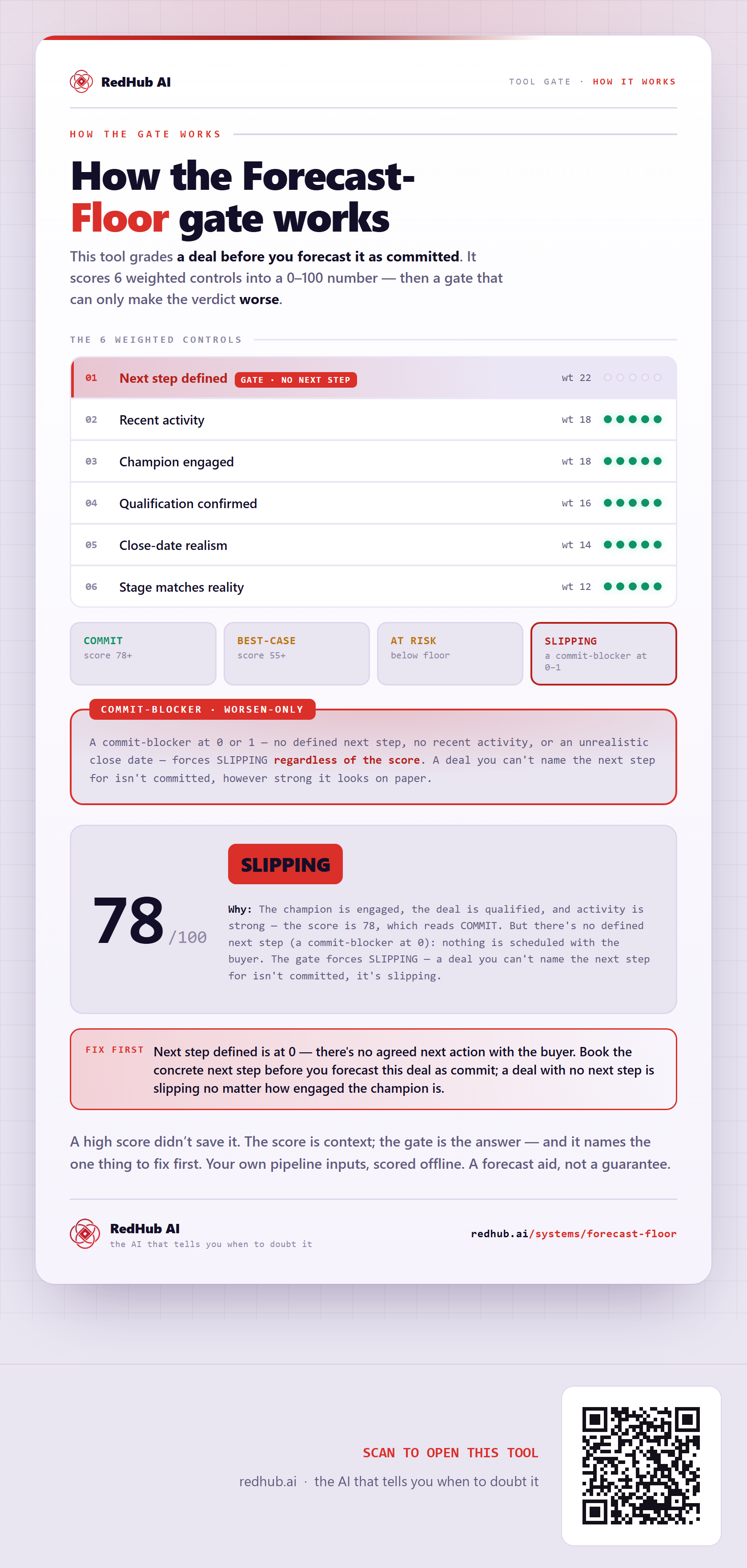
How the Forecast-Floor gate grades a deal before you forecast it: six signals weighted into a 0–100 score, with a commit-blocker gate where no defined next step forces SLIPPING regardless of the score — which is how a deal scoring 78 with an engaged champion still reads SLIPPING, because a deal you can't name the next step for isn't committed.
How the gate works
This tool grades a deal before you forecast it as committed. Each control is marked from your own evidence and weighted into a 0–100 score — and then the score is run past a gate that can only make the verdict worse.
The 6 weighted controls
| Signal | Weight |
|---|---|
| Next step defined | 22 |
| Recent activity | 18 |
| Champion engaged | 18 |
| Qualification confirmed | 16 |
| Close-date realism | 14 |
| Stage matches reality | 12 |
| Total | 100 |
The verdict bands
A commit-blocker at 0 or 1 — no defined next step, no recent activity, or an unrealistic close date — forces SLIPPING regardless of the score. A deal you can't name the next step for isn't committed, however strong it looks on paper.
In the worked sample it scores 78 out of 100 and still reads SLIPPING — The champion is engaged, the deal is qualified, and activity is strong — the score is 78, which reads COMMIT. But there's no defined next step (a commit-blocker at 0): nothing is scheduled with the buyer. The gate forces SLIPPING — a deal you can't name the next step for isn't committed, it's slipping. Marked fix first on this sample: Next step defined is at 0 — there's no agreed next action with the buyer. Book the concrete next step before you forecast this deal as commit; a deal with no next step is slipping no matter how engaged the champion is..
Common questions
Can something score well on the How the Forecast-Floor gate works and still fail?
Yes. The weighted score is run past a worsen-only gate — the Commit-blocker — that can only make the verdict worse. In the worked sample it scores 78 out of 100 and still reads SLIPPING, because the champion is engaged, the deal is qualified, and activity is strong — the score is 78, which reads COMMIT. But there's no defined next step (a commit-blocker at 0): nothing is scheduled with the buyer. The gate forces SLIPPING — a deal you can't name the next step for isn't committed, it's slipping.
What is a worsen-only gate?
A dispositive rule that can only lower a verdict, never raise it. One fatal flaw overrides an otherwise-good score, because a single disqualifying gap shouldn't hide behind a high average. Where something is short, the fix-first row names it — here, "Next step defined is at 0 — there's no agreed next action with the buyer. Book the concrete next step before you forecast this deal as commit; a deal with no next step is slipping no matter how engaged the champion is.".
Your own pipeline inputs, scored offline. A forecast aid, not a guarantee.
Embed this diagram
Free to share and embed with attribution (CC BY 4.0) — keep the link to redhub.ai.
Interactive — renders the live diagram
<iframe src="https://redhub.ai/visuals/tool/forecast-floor.html" title="How the Forecast-Floor gate works — RedHub AI" width="760" height="1669" loading="lazy" style="border:0;width:100%;max-width:760px"></iframe>
<p style="font:14px/1.5 system-ui,sans-serif"><a href="https://redhub.ai/visuals/tool/forecast-floor">How the Forecast-Floor gate works</a> — by <a href="https://redhub.ai">RedHub AI</a>, the AI that tells you when to doubt it.</p>
Image + link — a static picture for any blog
<a href="https://redhub.ai/visuals/tool/forecast-floor"><img src="https://redhub.ai/visuals/tool/forecast-floor-share.png" alt="Diagram of the Forecast-Floor gate: six weighted signals, a commit-blocker gate, and a deal scoring 78 forced to SLIPPING because there's no defined next step." width="760" loading="lazy" style="max-width:100%;height:auto;border-radius:16px"></a>
<p style="font:14px/1.5 system-ui,sans-serif"><a href="https://redhub.ai">RedHub AI</a> — the AI that tells you when to doubt it.</p>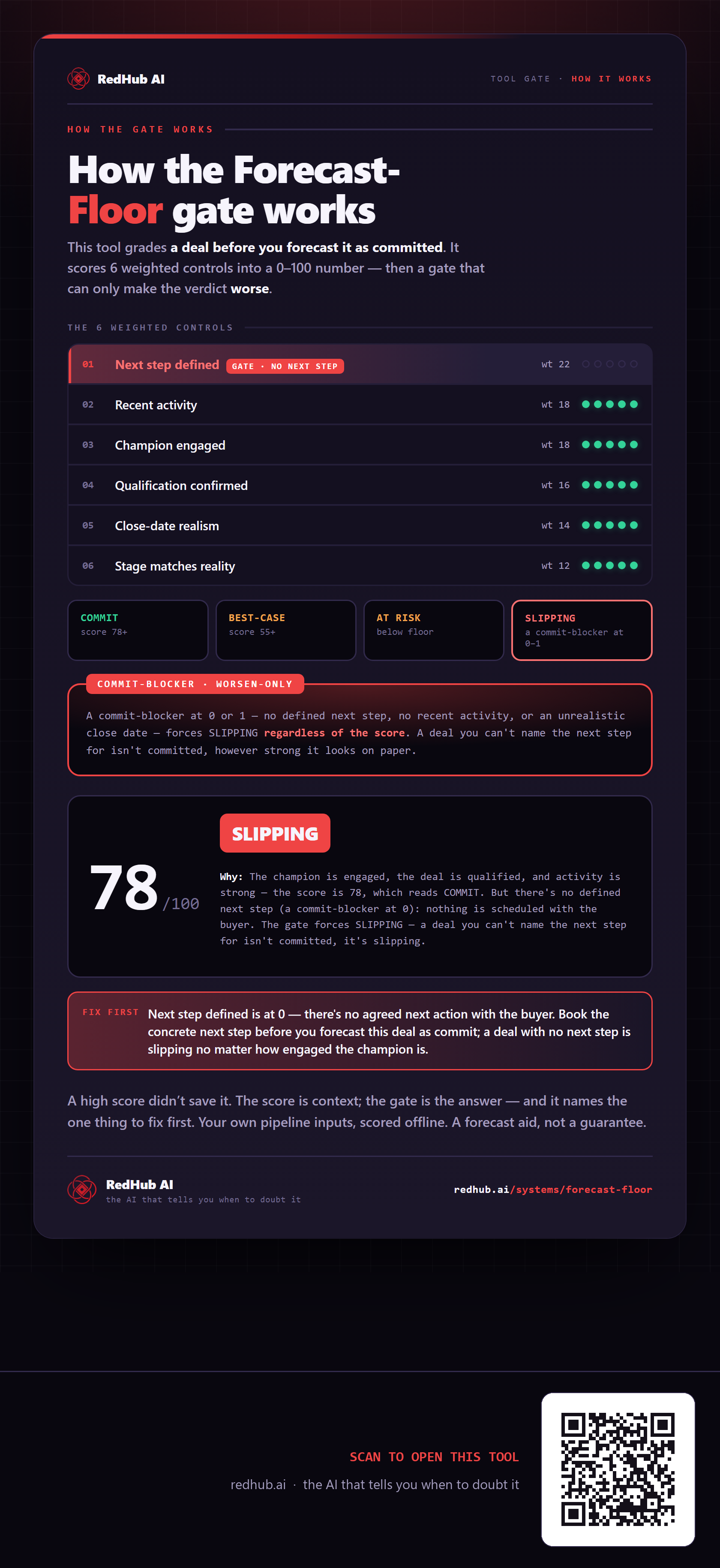
This is how Forecast-Floor works. More diagrams in the Visual Field Guide.