Tool Gate · How it works
How the Estimate-to-Actual Feedback Gate gate works
How the Estimate-to-Actual Feedback Gate reads eight closed jobs into one verdict: the practice reads on the share that fed back rather than its worst job, and a two-trigger gate catches what a share cannot - a comparison that was never possible, and a register where nothing ever changed the estimating basis. The sample has 71% feeding back and still returns LOOP OPEN.
How the gate works
This tool grades every closed job on whether what it cost ever reached the people who price the next one. It reads 8 closed jobs and rolls them into one verdict — the worst, never the average — and then a gate that can only make it worse.
The 8 closed jobs
| Closed job | Verdict |
|---|---|
| J-1041 · Northgate Clinic | FED BACK83 · closed, mapped, causes named — basis untouched |
| J-1052 · Harbor Point Retail | FED BACK83 · closed, mapped, causes named — basis untouched |
| J-1063 · Westline Warehouse | FED BACK75 · retrievable only by rebuilding it |
| J-1074 · Cedar Ridge Apartments | FED BACK83 · closed, mapped, causes named — basis untouched |
| J-1085 · Municipal Annexfix first | LOST33 · cost codes do not map to the estimate |
| J-1096 · Riverside Pump Station | FED BACK75 · the estimator never saw the result |
| J-1107 · Fairmount School | OUT OF SCOPEdeclared out of scope, and reported |
| J-1118 · Glenview Medical | PARTIAL67 · estimator not looped in, comparison not retrievable |
The verdict bands
Two triggers, and the second is unusual. Any job whose cost codes do not map to its estimate forces LOOP OPEN, because that comparison is not merely undone — it is not possible, and it is invisible to anyone measuring drift since there is nothing to measure. The second reads the WHOLE register rather than any row: if no job anywhere ever changed the estimating basis, the loop has never once closed. One basis update anywhere releases it, and a recorded decision to change nothing counts.
In the worked sample it reads LOOP OPEN — Five of seven in-scope jobs read FED BACK and 71% of the practice fed back, which is a respectable number. Both triggers still fire. Municipal Annex's cost codes do not map to its estimate, so that comparison was never possible. And across all seven jobs, not one ever changed the estimating basis — a condition on the register rather than on any row, and the one a share can never see. Marked fix first on this sample: J-1085 Municipal Annex · cost codes map to the estimate — the structural blocker, ahead of every habit.
Common questions
Can every closed job look survivable on the How the Estimate-to-Actual Feedback gate works and the company still read LOOP OPEN?
Yes. The roll-up takes the worst of 8 closed jobs — never the average — then a worsen-only gate, the Feedback gate gate, escalates when trouble clusters. In the worked sample it reads LOOP OPEN because five of seven in-scope jobs read FED BACK and 71% of the practice fed back, which is a respectable number. Both triggers still fire. Municipal Annex's cost codes do not map to its estimate, so that comparison was never possible. And across all seven jobs, not one ever changed the estimating basis — a condition on the register rather than on any row, and the one a share can never see.
What is a worsen-only gate?
A rule that can only lower a verdict, never raise it. One gate-triggering gap overrides an otherwise-set of survivable lines, because a single gate-triggering gap shouldn't hide behind an average of the healthy ones. Where something is short, the fix-first row names it — here, "J-1085 Municipal Annex · cost codes map to the estimate — the structural blocker, ahead of every habit".
Grades a register of closed jobs you fill in, never a person. It reads no accounting system, no estimate and no job cost, computes no variance, productivity factor or unit cost, and makes no claim that your numbers are good — only about whether anyone ever found out.
Embed this diagram
Free to share and embed with attribution (CC BY 4.0) — keep the link to redhub.ai.
Interactive — renders the live diagram
<iframe src="https://redhub.ai/visuals/tool/estimate-to-actual-feedback-gate.html" title="How the Estimate-to-Actual Feedback Gate gate works — RedHub AI" width="760" height="2291" loading="lazy" style="border:0;width:100%;max-width:760px"></iframe>
<p style="font:14px/1.5 system-ui,sans-serif"><a href="https://redhub.ai/visuals/tool/estimate-to-actual-feedback-gate">How the Estimate-to-Actual Feedback Gate gate works</a> — by <a href="https://redhub.ai">RedHub AI</a>, the AI that tells you when to doubt it.</p>
Image + link — a static picture for any blog
<a href="https://redhub.ai/visuals/tool/estimate-to-actual-feedback-gate"><img src="https://redhub.ai/visuals/tool/estimate-to-actual-feedback-gate-share.png" alt="Diagram of the Estimate-to-Actual Feedback Gate: eight closed construction jobs each marked fed back, partial or lost, one job flagged fix-first because its cost codes do not map to its estimate, a two-trigger feedback gate, and a sample verdict reading LOOP OPEN." width="760" loading="lazy" style="max-width:100%;height:auto;border-radius:16px"></a>
<p style="font:14px/1.5 system-ui,sans-serif"><a href="https://redhub.ai">RedHub AI</a> — the AI that tells you when to doubt it.</p>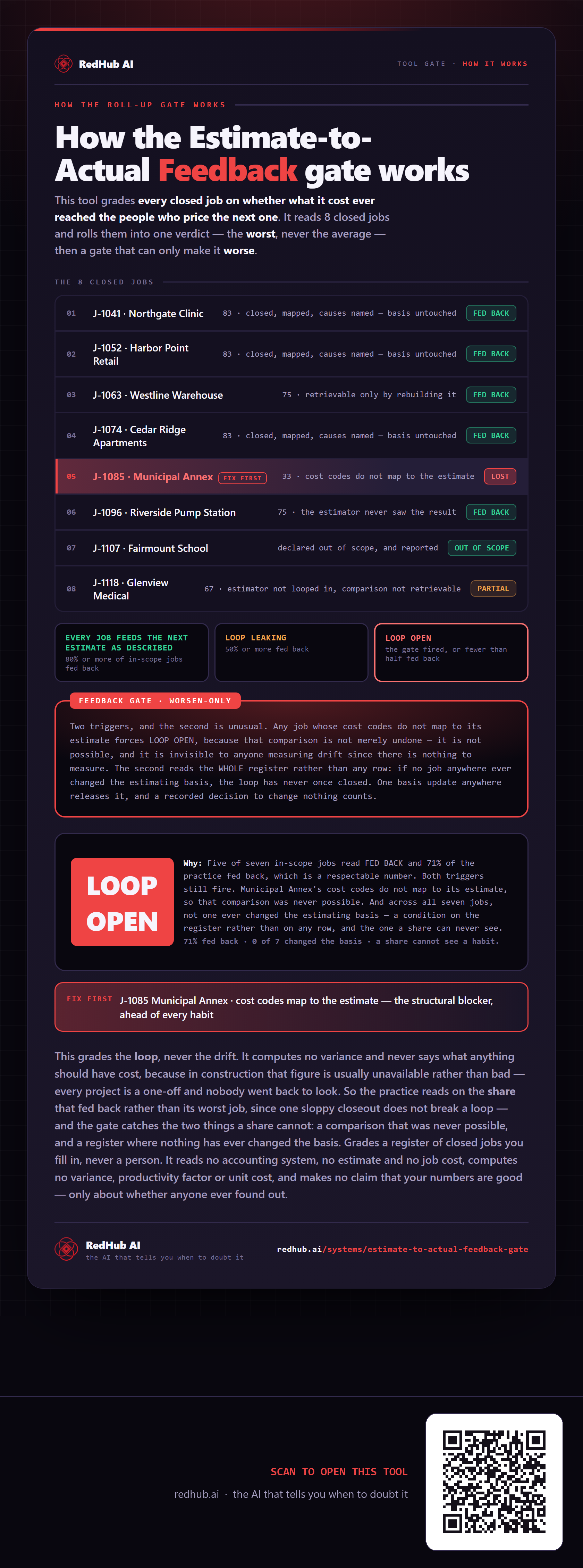
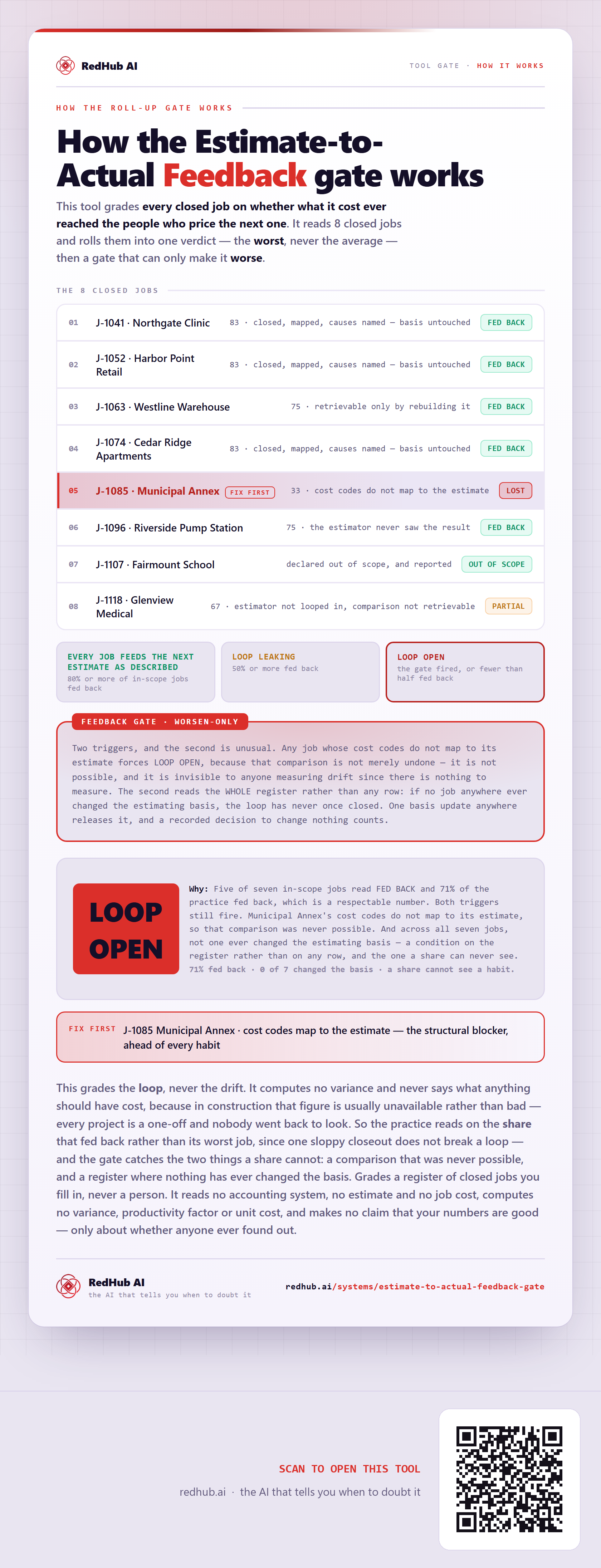
This is how Estimate-to-Actual Feedback Gate works. More diagrams in the Visual Field Guide.