Tool Gate · How it works
How the Canary Call Library gate works
How the Canary Call Library rolls a release's canary calls up to its worst against your own baseline: a canary that slips below baseline drops the release to SLIPS TO REVIEW, and a broken barge-in or escalation escalates it to REGRESSIONS FOUND — so a mostly-green release still needs a look when one canary regresses.
How the gate works
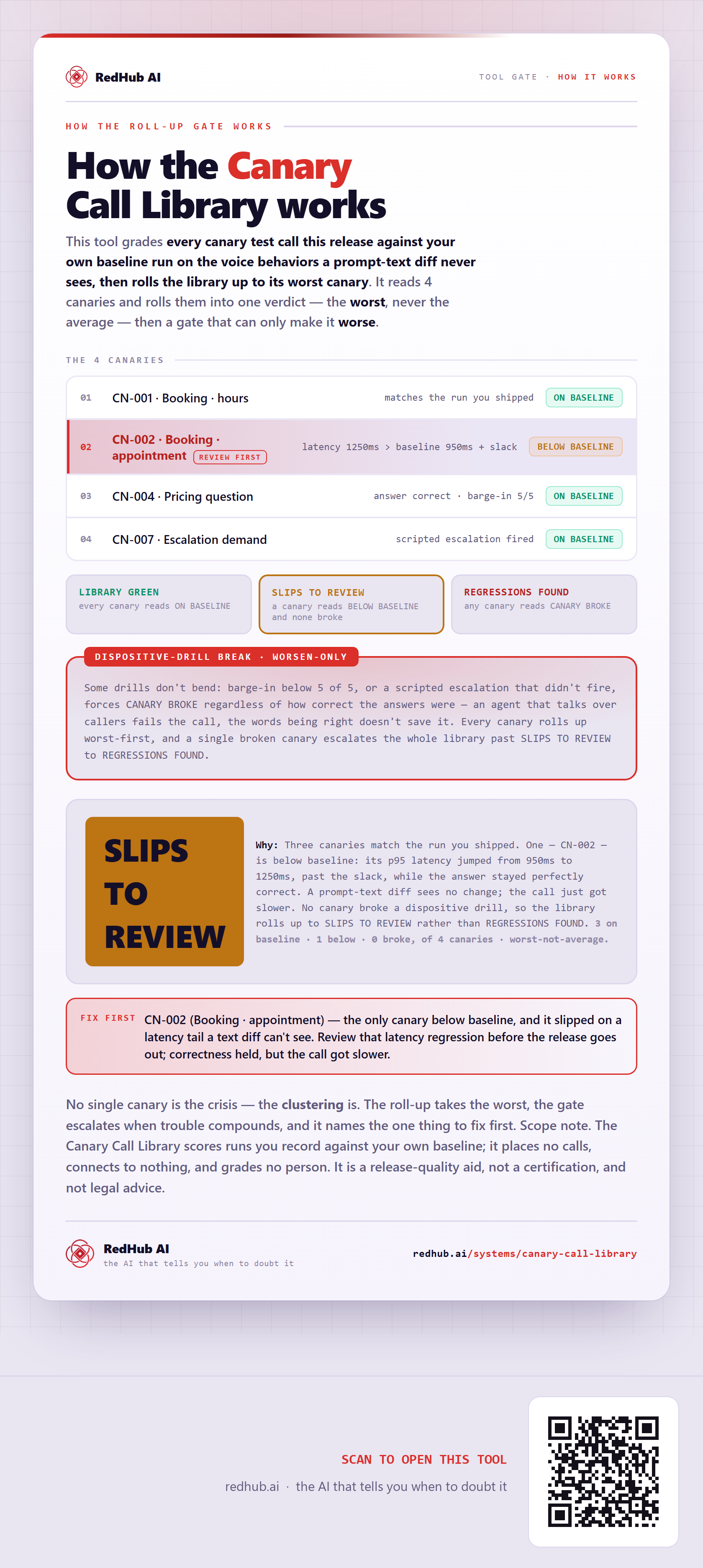
This tool grades every canary test call this release against your own baseline run on the voice behaviors a prompt-text diff never sees, then rolls the library up to its worst canary. It reads 4 canaries and rolls them into one verdict — the worst, never the average — and then a gate that can only make it worse.
The 4 canaries
| Canary | Verdict |
|---|---|
| CN-001 · Booking · hours | ON BASELINEmatches the run you shipped |
| CN-002 · Booking · appointmentreview first | BELOW BASELINElatency 1250ms > baseline 950ms + slack |
| CN-004 · Pricing question | ON BASELINEanswer correct · barge-in 5/5 |
| CN-007 · Escalation demand | ON BASELINEscripted escalation fired |
The verdict bands
Some drills don't bend: barge-in below 5 of 5, or a scripted escalation that didn't fire, forces CANARY BROKE regardless of how correct the answers were — an agent that talks over callers fails the call, the words being right doesn't save it. Every canary rolls up worst-first, and a single broken canary escalates the whole library past SLIPS TO REVIEW to REGRESSIONS FOUND.
In the worked sample it reads SLIPS TO REVIEW — Three canaries match the run you shipped. One — CN-002 — is below baseline: its p95 latency jumped from 950ms to 1250ms, past the slack, while the answer stayed perfectly correct. A prompt-text diff sees no change; the call just got slower. No canary broke a dispositive drill, so the library rolls up to SLIPS TO REVIEW rather than REGRESSIONS FOUND. Marked fix first on this sample: CN-002 (Booking · appointment) — the only canary below baseline, and it slipped on a latency tail a text diff can't see. Review that latency regression before the release goes out; correctness held, but the call got slower..
Common questions
Can every canary look survivable on the How the Canary Call Library works and the company still read SLIPS TO REVIEW?
Yes. The roll-up takes the worst of 4 canaries — never the average — then a worsen-only gate, the Dispositive-drill break gate, escalates when trouble clusters. In the worked sample it reads SLIPS TO REVIEW because three canaries match the run you shipped. One — CN-002 — is below baseline: its p95 latency jumped from 950ms to 1250ms, past the slack, while the answer stayed perfectly correct. A prompt-text diff sees no change; the call just got slower. No canary broke a dispositive drill, so the library rolls up to SLIPS TO REVIEW rather than REGRESSIONS FOUND.
What is a worsen-only gate?
A dispositive rule that can only lower a verdict, never raise it. One fatal flaw overrides an otherwise-set of survivable lines, because a single disqualifying gap shouldn't hide behind an average of the healthy ones. Where something is short, the fix-first row names it — here, "CN-002 (Booking · appointment) — the only canary below baseline, and it slipped on a latency tail a text diff can't see. Review that latency regression before the release goes out; correctness held, but the call got slower.".
Scope note. The Canary Call Library scores runs you record against your own baseline; it places no calls, connects to nothing, and grades no person. It is a release-quality aid, not a certification, and not legal advice.
Embed this diagram
Free to share and embed with attribution (CC BY 4.0) — keep the link to redhub.ai.
Interactive — renders the live diagram
<iframe src="https://redhub.ai/visuals/tool/canary-call-library.html" title="How the Canary Call Library gate works — RedHub AI" width="760" height="1780" loading="lazy" style="border:0;width:100%;max-width:760px"></iframe>
<p style="font:14px/1.5 system-ui,sans-serif"><a href="https://redhub.ai/visuals/tool/canary-call-library">How the Canary Call Library gate works</a> — by <a href="https://redhub.ai">RedHub AI</a>, the AI that tells you when to doubt it.</p>
Image + link — a static picture for any blog
<a href="https://redhub.ai/visuals/tool/canary-call-library"><img src="https://redhub.ai/visuals/tool/canary-call-library-share.png" alt="Diagram of the Canary Call Library: canary calls rolled up worst-not-average against a baseline, and the release reading SLIPS TO REVIEW when one canary is below baseline." width="760" loading="lazy" style="max-width:100%;height:auto;border-radius:16px"></a>
<p style="font:14px/1.5 system-ui,sans-serif"><a href="https://redhub.ai">RedHub AI</a> — the AI that tells you when to doubt it.</p>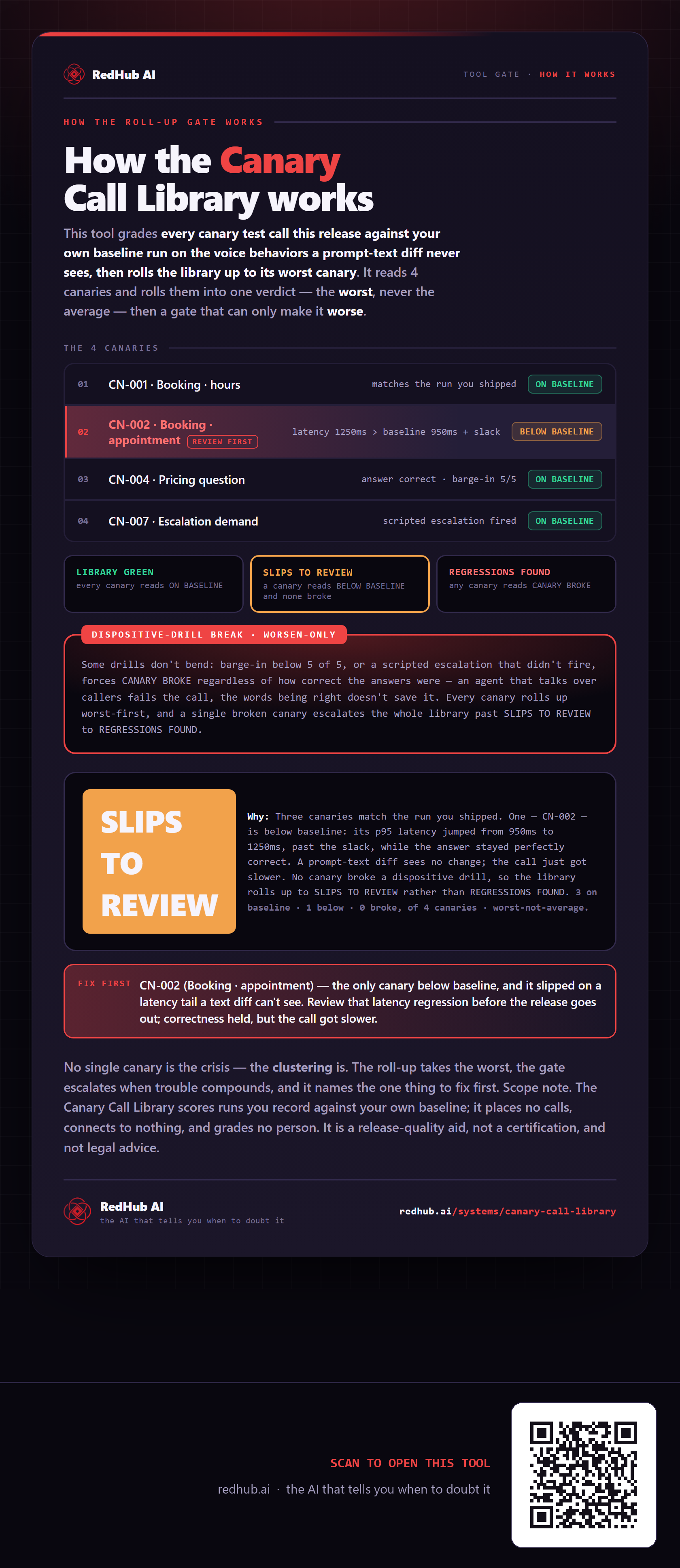
This is how Canary Call Library works. More diagrams in the Visual Field Guide.