Tool Gate · How it works
How the AI Incident Reporting & Regulatory-Notification Drill gate works
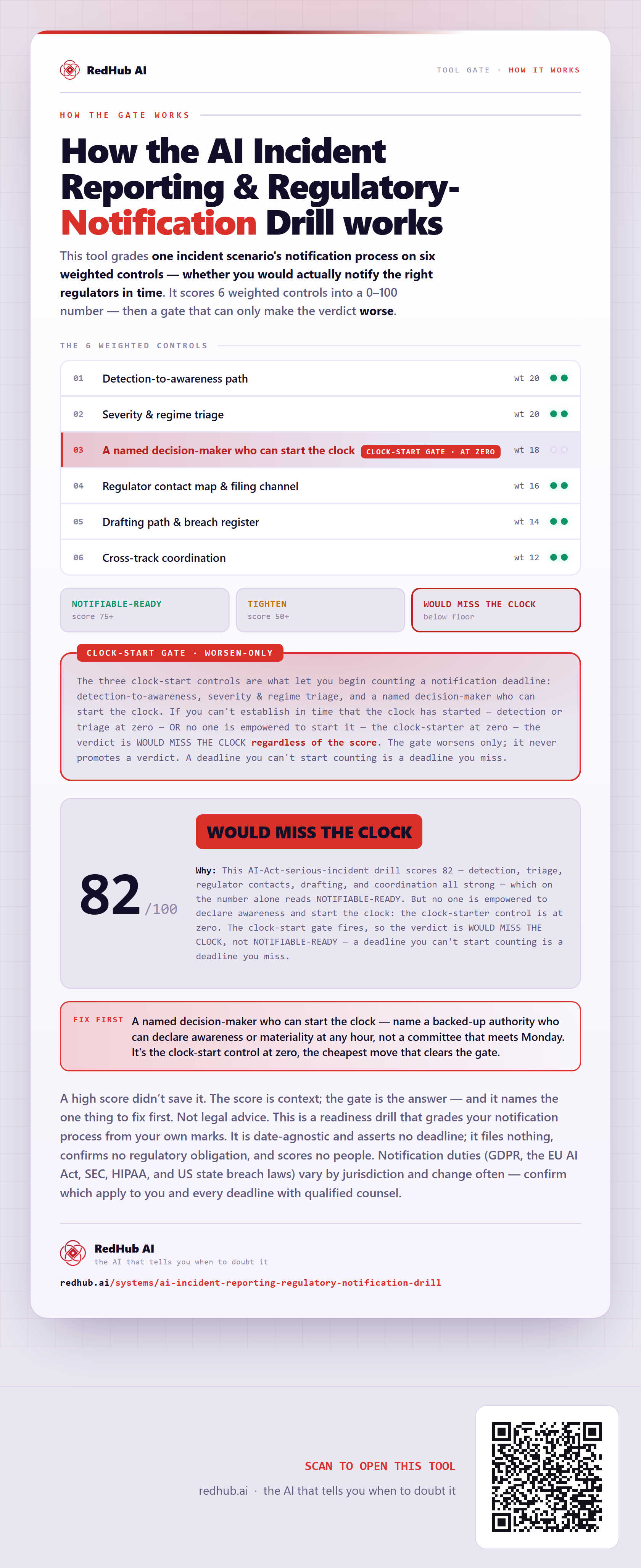
How the AI Incident Reporting & Regulatory-Notification Drill scores whether you'd notify in time across the readiness signals — then a clock-start gate forces WOULD MISS THE CLOCK when the trigger that starts the notification clock isn't in place, so a high overall drill score still misses the deadline.
How the gate works
This tool grades one incident scenario's notification process on six weighted controls — how ready your process is to notify the right regulators in time, on your own marks. Each control is marked from your own evidence and weighted into a 0–100 score — and then the score is run past a gate that can only make the verdict worse.
The 6 weighted controls
| Signal | Weight |
|---|---|
| Detection-to-awareness path | 20 |
| Severity & regime triage | 20 |
| A named decision-maker who can start the clock | 18 |
| Regulator contact map & filing channel | 16 |
| Drafting path & breach register | 14 |
| Cross-track coordination | 12 |
| Total | 100 |
The verdict bands
The three clock-start controls are what let you notice in time that a clock has already started: detection-to-awareness, severity & regime triage, and a named decision-maker who can start the clock. If you can't establish in time that the clock has started — detection or triage at zero — OR no one is empowered to start it — the clock-starter at zero — the verdict is WOULD MISS THE CLOCK regardless of the score. The gate worsens only; it never promotes a verdict. A deadline you can't start counting is a deadline you are unlikely to meet.
In the worked sample it scores 82 out of 100 and still reads WOULD MISS THE CLOCK — This hypothetical Annex III serious-incident drill scores 82 — detection, triage, regulator contacts, drafting, and coordination all strong — which on the number alone reads NOTIFIABLE-READY AS DESCRIBED. But no one is empowered to declare awareness and start the clock: the clock-starter control is at zero. The clock-start gate fires, so the verdict is WOULD MISS THE CLOCK, not NOTIFIABLE-READY AS DESCRIBED — a deadline you can't start counting is a deadline you are unlikely to meet. Marked fix first on this sample: A named decision-maker who can start the clock — name a backed-up authority who can declare awareness or materiality at any hour, not a committee that meets Monday. It's the clock-start control at zero, the cheapest move that clears the gate..
Common questions
Can something score well on the How the AI Incident Reporting & Regulatory-Notification Drill works and still fail?
Yes. The weighted score is run past a worsen-only gate — the Clock-start gate — that can only make the verdict worse. In the worked sample it scores 82 out of 100 and still reads WOULD MISS THE CLOCK, because this hypothetical Annex III serious-incident drill scores 82 — detection, triage, regulator contacts, drafting, and coordination all strong — which on the number alone reads NOTIFIABLE-READY AS DESCRIBED. But no one is empowered to declare awareness and start the clock: the clock-starter control is at zero. The clock-start gate fires, so the verdict is WOULD MISS THE CLOCK, not NOTIFIABLE-READY AS DESCRIBED — a deadline you can't start counting is a deadline you are unlikely to meet.
What is a worsen-only gate?
A dispositive rule that can only lower a verdict, never raise it. One fatal flaw overrides an otherwise-good score, because a single disqualifying gap shouldn't hide behind a high average. Where something is short, the fix-first row names it — here, "A named decision-maker who can start the clock — name a backed-up authority who can declare awareness or materiality at any hour, not a committee that meets Monday. It's the clock-start control at zero, the cheapest move that clears the gate.".
Not legal advice. This is a readiness drill that grades your notification process from your own marks. It is date-agnostic and asserts no deadline; it files nothing, confirms no regulatory obligation, and scores no people. Notification duties (GDPR, the EU AI Act, SEC, HIPAA, and US state breach laws) vary by jurisdiction and change often — confirm which apply to you and every deadline with qualified counsel.
Embed this diagram
Free to share and embed with attribution (CC BY 4.0) — keep the link to redhub.ai.
Interactive — renders the live diagram
<iframe src="https://redhub.ai/visuals/tool/ai-incident-reporting-regulatory-notification-drill.html" title="How the AI Incident Reporting & Regulatory-Notification Drill gate works — RedHub AI" width="760" height="2052" loading="lazy" style="border:0;width:100%;max-width:760px"></iframe>
<p style="font:14px/1.5 system-ui,sans-serif"><a href="https://redhub.ai/visuals/tool/ai-incident-reporting-regulatory-notification-drill">How the AI Incident Reporting & Regulatory-Notification Drill gate works</a> — by <a href="https://redhub.ai">RedHub AI</a>, the AI that tells you when to doubt it.</p>
Image + link — a static picture for any blog
<a href="https://redhub.ai/visuals/tool/ai-incident-reporting-regulatory-notification-drill"><img src="https://redhub.ai/visuals/tool/ai-incident-reporting-regulatory-notification-drill-share.png" alt="Diagram of the AI Incident Reporting & Regulatory-Notification Drill: notification readiness scored to 0-100 and a clock-start gate forcing WOULD MISS THE CLOCK." width="760" loading="lazy" style="max-width:100%;height:auto;border-radius:16px"></a>
<p style="font:14px/1.5 system-ui,sans-serif"><a href="https://redhub.ai">RedHub AI</a> — the AI that tells you when to doubt it.</p>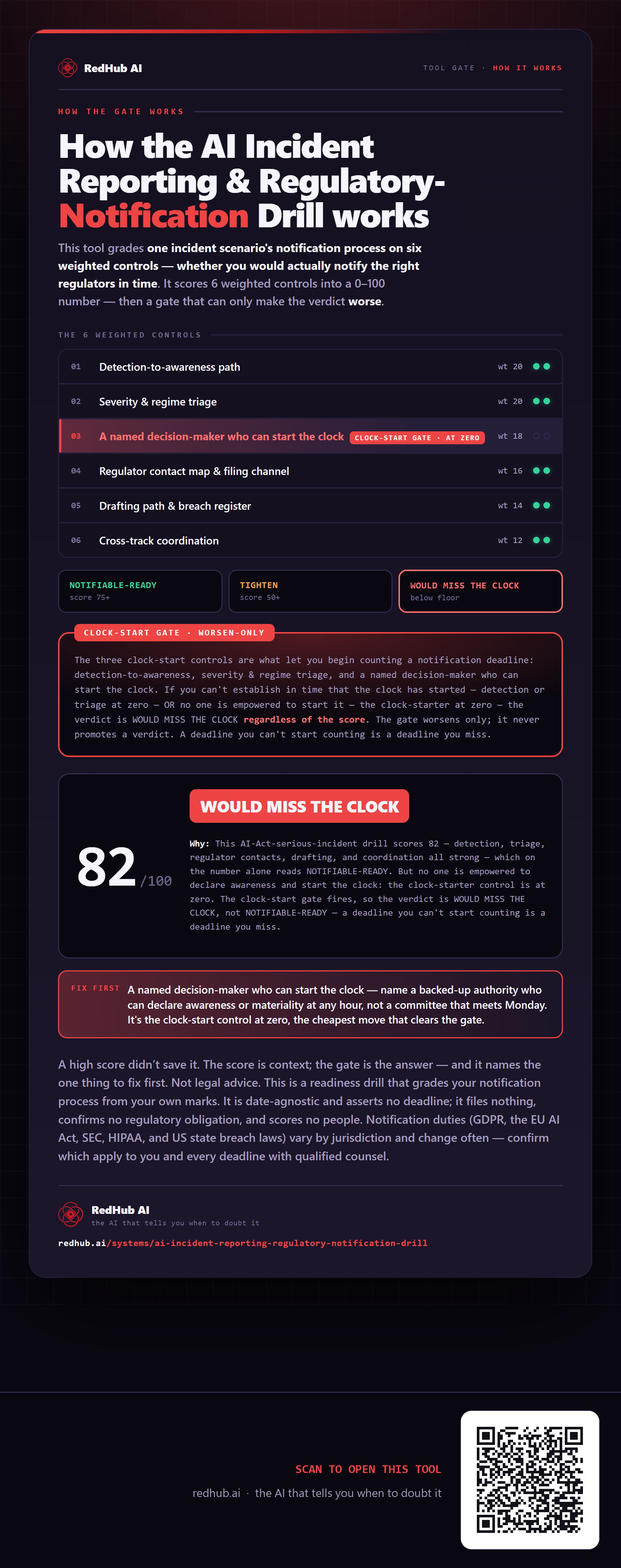
This is how AI Incident Reporting & Regulatory-Notification Drill works. More diagrams in the Visual Field Guide.