AI Vendor Claim & Contract Scrutiny Kit
Every AI vendor's deck reads great. This kit scores their claims one by one on two things that actually protect you — is it proven, and is it in the contract — and tells you which ones to get in writing before you commit a dollar.
instant download · .xlsx · yours to keep
This kit is a scrutiny aid for your own vendor evaluation — not legal advice. It scores the vendor's pitch artifact, not people, and does not interpret your contract or determine legal rights. Substantiation of marketing claims is governed by the FTC; have counsel review any agreement before you sign.
The problem
The pitch is polished. The exposure is in what isn't written down.
“Fully agentic.” “Cuts cost 40%.” “Your data is never used for training.” Vendors lead with the claims that close the deal — and the ones that matter most are often the ones with the least behind them. A claim is only as good as the proof you can check and the contract language you can enforce. This kit makes that difference visible per claim, before you sign, instead of after something breaks.
See it work
Five clean claims. One unbacked ROI promise. Still WALK AWAY.
Northwind's uptime, security, data-handling, integration, and support claims all hold up. Its “cuts cost 40% in 90 days” ROI claim has no proof and isn't in the contract — so the high-stakes gate fires and the vendor reads WALK AWAY. Drag the proof or contract marks up on that claim and watch the gate release.
Vendor: Northwind AI Platform
Mark each claim 0–3 on proof and on contract backing. The verdict follows the weaker axis.
High-stakes gate: a ROI or autonomy claim is unproven and not in the contract — the vendor is WALK AWAY no matter how clean every other claim reads. Add any proof or any contract language and the gate releases.
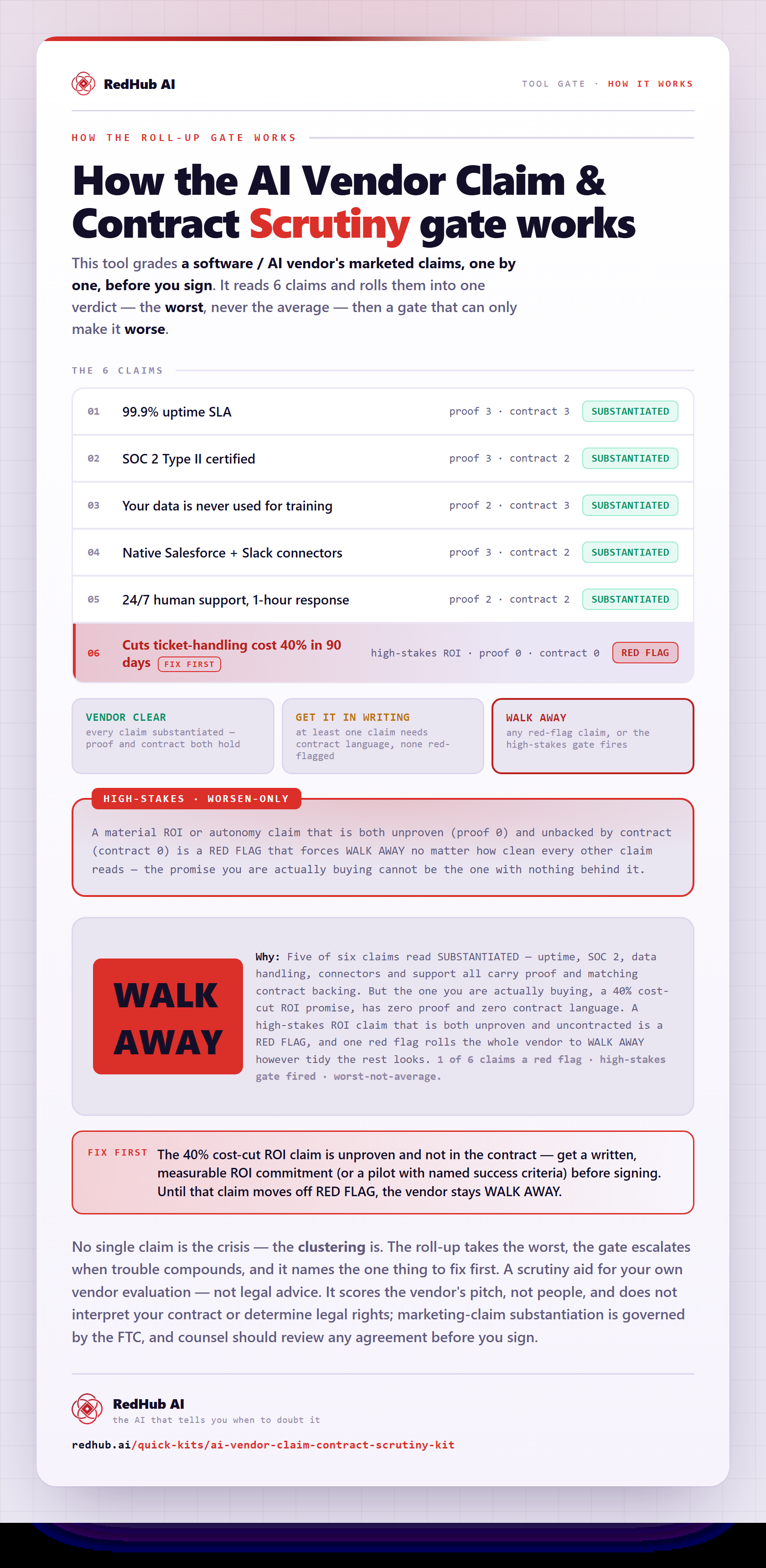
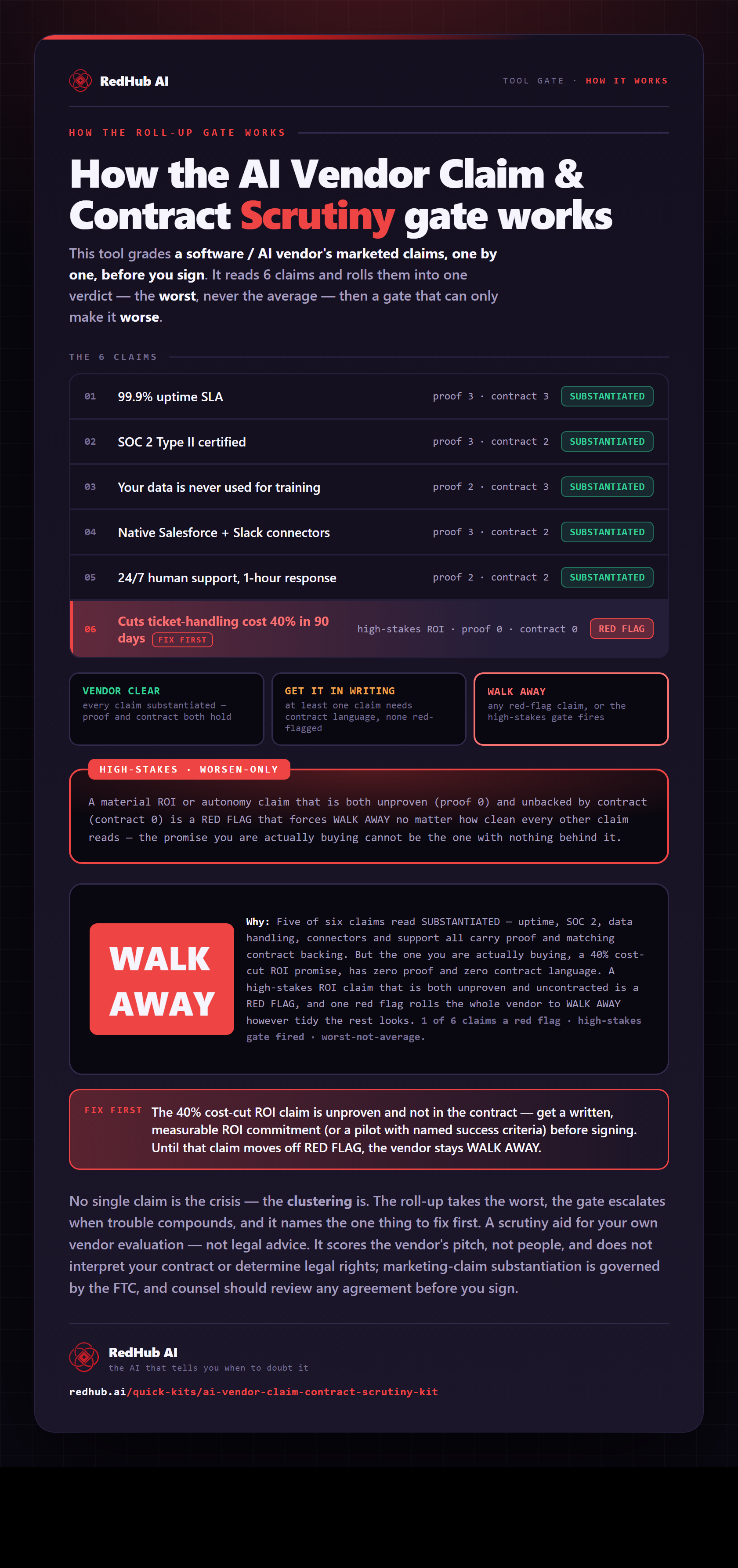
How the gate works, in one image
How the AI Vendor Claim & Contract Scrutiny Kit grades a vendor claim-by-claim and forces WALK AWAY on a material claim that's both unproven and uncontracted — the same math the demo runs, as a diagram you can share or embed anywhere.
View & embed the full diagramThe standard
The weaker axis wins, and the gate only ever holds back.
Two axes, MIN-capped
Verifiability and contract backing, each 0–3. The per-claim verdict follows the weaker of the two — proven-but-unwritten and written-but-unproven both fall short of SUBSTANTIATED.
A high-stakes gate
An ROI or autonomy claim that's both unproven and not in the contract is forced to RED FLAG and forces WALK AWAY — regardless of how the other claims score. Worsen-only: it never promotes a vendor.
Your marks, no benchmark
The verdict comes from your own reading of the pitch and the draft agreement. No baked-in industry multiplier, nothing uploaded, the vendor never contacted.
How it works
Three tabs, one afternoon.
- 01
On Claim Scrutiny, list every claim the vendor makes. Tag its category and whether a purchase decision rests on it.
- 02
Mark each claim 0–3 on proof and 0–3 on contract backing. The verdict computes live.
- 03
Read the Dashboard: each vendor's posture, and the claims to get in writing. Take the GET IN WRITING list into the negotiation.
What this is — and isn't
It grades the pitch you assemble — not your systems, not people.
It is
- A claim-by-claim scrutiny of a vendor's marketed promises before you sign.
- A way to separate what's proven and enforceable from what's just sales talk.
- A GET IN WRITING list you carry into the negotiation.
It isn't
- A contract review or legal opinion — that's the Inbound Contract & SOW Risk Gate plus counsel.
- A reliability scorecard of a tool you already run on your own usage data.
- An assessment of any person; it scores the pitch artifact only.
This kit is a scrutiny aid for your own vendor evaluation — not legal advice. It scores the vendor's pitch artifact, not people, and does not interpret your contract or determine legal rights. Substantiation of marketing claims is governed by the FTC; have counsel review any agreement before you sign.
Who it's for
Anyone signing an AI vendor on the strength of a pitch.
For
- Founders and operators evaluating AI tools without a procurement team.
- Anyone comparing two vendors whose decks both look airtight.
- Teams who've been burned by an “agentic” or ROI promise that didn't hold.
Not for
- Reviewing the contract clauses themselves — use the Contract & SOW Risk Gate.
- Deciding whether to renew a tool you already use — use the Reliability Scorecard.
- Anyone wanting a guaranteed outcome; this surfaces risk, it doesn't remove it.
Pairs well with
The full vendor path: scrutinize, sign, govern, renew.
Inbound Contract & SOW Risk Gate
Once you have the claims pinned down, triage the contract clauses themselves — SIGN / NEGOTIATE / UNSIGNABLE AS DRAFTED.
AI Vendor Reliability & Spend-Justification Scorecard
After you've signed and used it, decide renewal from your own reliability and value data — RENEW / RENEGOTIATE / DO NOT RENEW.
AI Vendor & Sub-Processor Data-Flow Register
Govern what the vendor's tools actually touch — a register of data flows graded DOCUMENTED / GAP / UNVETTED.
Common questions
The questions buyers actually ask before they sign a vendor.
That scorecard grades a vendor you already use, from your own usage and reliability data, to decide renewal. This kit works one step earlier: it scrutinizes the claims in a vendor's pitch before you sign, on whether each claim is verifiable and whether it's actually in the contract. One is renewal from your data; this is the pitch before you commit.
Verifiability (0–3): is there proof — none, vendor self-asserted, secondary, or primary checkable proof like a named reference or audited report. Contract backing (0–3): is it in the signed agreement — not at all, in a non-binding doc, soft/best-efforts, or a defined commitment with a remedy like an SLA credit or exit right. The per-claim verdict follows the weaker of the two, so a claim that's proven but not in writing — or in writing but unproven — can't read SUBSTANTIATED.
An ROI promise or an 'agentic'/autonomy claim that is both unproven and not in the contract is forced to RED FLAG, and that forces the whole vendor to WALK AWAY — regardless of how clean every other claim is. In the worked example one vendor has five substantiated claims and still lands WALK AWAY because its 40%-cost-cut ROI claim has no proof and no contract language. Add any proof or any contract backing and the gate releases.
No. It's offline and self-contained. You enter the claims and your own marks from the vendor's deck, proposal, and any draft agreement; nothing is uploaded and the vendor is never contacted. It scores the pitch artifact you assemble, not the vendor's systems and not any person.
No. It's a scrutiny aid for your own evaluation — it surfaces which claims are thin and which carry real backing so you know what to get in writing before you sign. It is not legal advice and does not interpret your contract or determine legal rights. For the contract document itself, the Inbound Contract & SOW Risk Gate triages clause risk; have counsel review any agreement before signing.
One .xlsx with three tabs — Start Here, Dashboard, and Claim Scrutiny — with live formulas that reproduce the per-claim verdicts, the high-stakes gate, and the vendor postures, plus a worked three-vendor example you overwrite with your own. It opens in Excel, Google Sheets, or Numbers; no install, no login.
Get the kit
Know what to get in writing — before you sign.
- One .xlsx · three tabs · live formulas · worked example.
- Opens in Excel, Google Sheets, or Numbers.
- Yours to keep — no login, nothing uploaded.
Sold by RedHub AI LLC · Secured by Stripe · redhub.ai