AI-Assisted Pricing-Change Defensibility Kit
AI pricing tools are fast, confident, and perfectly happy to hand you a price built on an invented benchmark — or one that quietly sits below your margin floor. This kit grades the recommendation before it goes live.
instant download · .xlsx · yours to keep
This kit is a defensibility aid for your own pre-publish review — not financial or legal advice. It grades the pricing recommendation artifact, not people, and sets no price for you. Competitive and savings claims you publish can carry FTC substantiation obligations; confirm anything material with the appropriate advisor.
The problem
The AI's pricing case sounds airtight. Then you check the numbers behind it.
“Competitors charge 20% more.” “Industry-standard margin is 65%.” “Demand is inelastic at this tier.” An AI tool will assemble a confident pricing recommendation in seconds — and some of the figures holding it up are invented, stale, or simply not in any source. Publish on top of that and you've made a defensibility problem into a public one. This kit pulls the recommendation apart on the four things that actually decide whether it holds.
See it work
Healthy margin. Fabricated benchmark. Still DO NOT PUBLISH.
This Pro-tier increase clears its margin floor with room to spare — and still reads DO NOT PUBLISH, because the competitive case rests on a benchmark that doesn't check out. Flip the benchmark to real, or fix the competitive claim, and watch the verdict move.
AI-suggested change
Pro tier +12% (AI rec)
Gate: a fabricated benchmark forces DO NOT PUBLISH — no matter how clean the rest of the recommendation reads. Make the benchmark real and the gate releases.
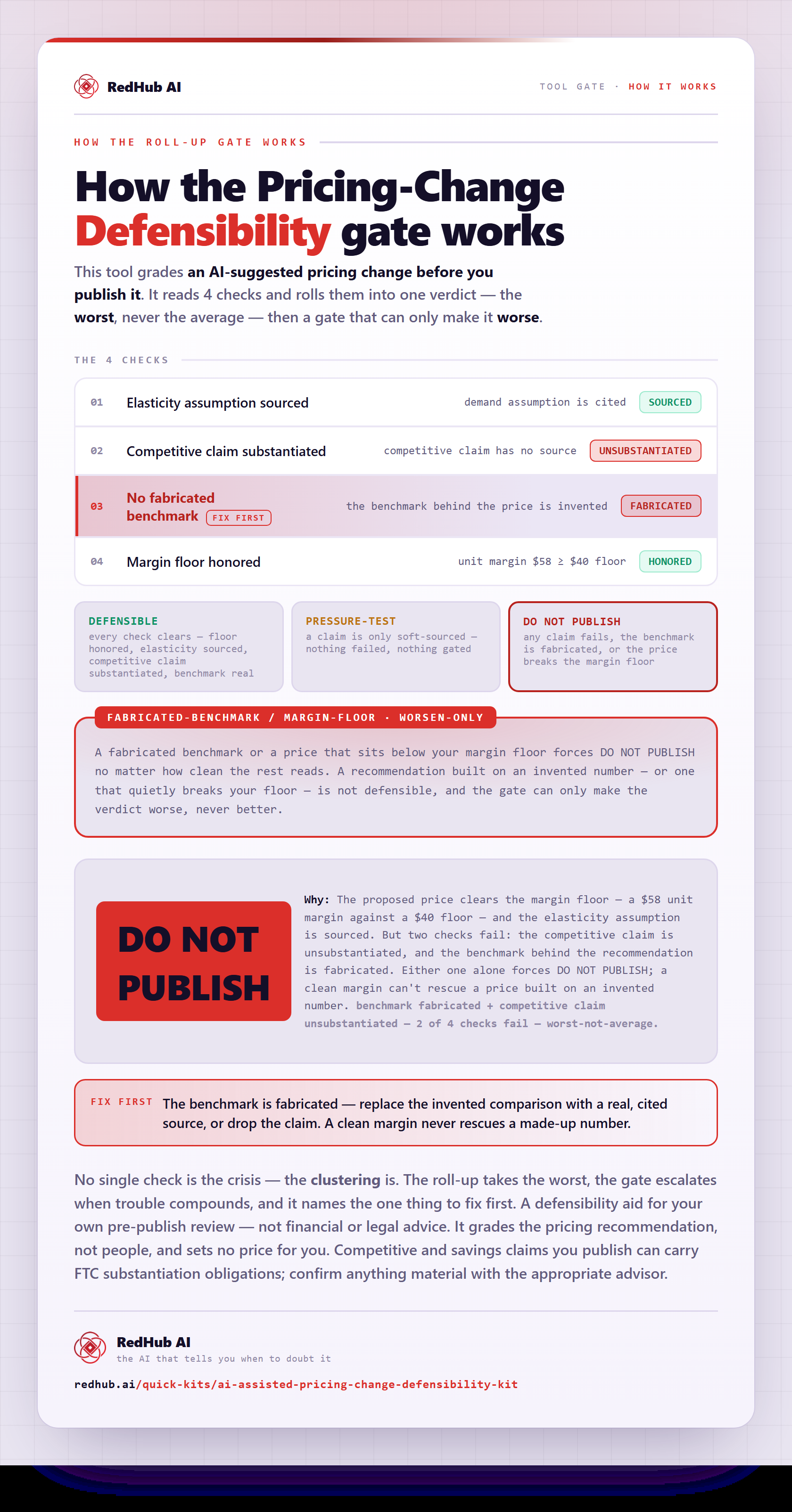
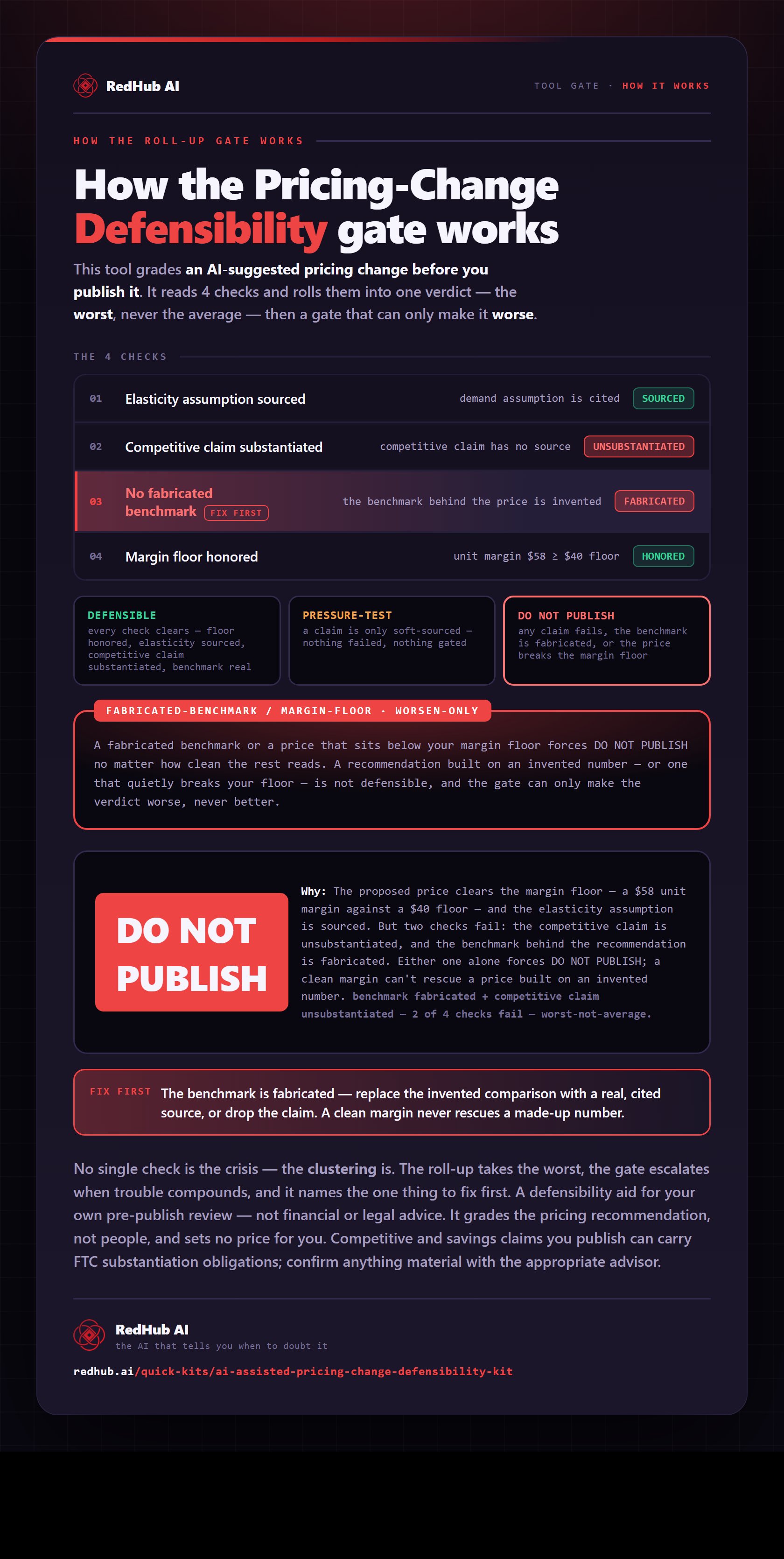
How the gate works, in one image
How the AI-Assisted Pricing-Change Defensibility Kit rolls a price-change announcement up to its worst check and reads DO NOT PUBLISH on an unbacked benchmark — the same math the demo runs, as a diagram you can share or embed anywhere.
View & embed the full diagramThe standard
Computed where it can be. Gated where it must be.
The margin floor is math
Proposed price minus unit cost, tested against the floor you set — not a judgment call. A below-floor price loses money by construction.
The fabrication gate
An invented benchmark or a below-floor price forces DO NOT PUBLISH regardless of the rest. Worsen-only: it never waves a bad price through.
Your floor, your marks
No baked-in industry multiplier and no recommended price. The verdict comes from your floor and your reading of the AI's sources.
How it works
One change, four marks, a verdict.
- 01
Enter the AI-suggested change: proposed price, unit cost, and your margin floor. The kit computes the unit margin and tests the floor.
- 02
Mark the elasticity and competitive claims pass / soft / fail, and the benchmarks real or fabricated.
- 03
Read the verdict and, where a check is short, the one thing to fix first. Tighten it, or send it back to the AI, before anything publishes.
What this is — and isn't
It audits the AI's recommendation — it doesn't set your price.
It is
- A pre-publish defensibility check on an AI-suggested price change.
- A fabrication and sourcing gate — does the case rest on anything real.
- A one-thing-to-fix-first verdict you can act on in minutes.
It isn't
- A pricing recommender — it sets no price and applies no industry multiplier.
- The decision of whether to change a price — that's Should I Raise My Prices?
- A margin audit of deals already on the books — that's the Margin Leak Auditor.
This kit is a defensibility aid for your own pre-publish review — not financial or legal advice. It grades the pricing recommendation artifact, not people, and sets no price for you. Competitive and savings claims you publish can carry FTC substantiation obligations; confirm anything material with the appropriate advisor.
Who it's for
Anyone shipping a price an AI helped set.
For
- Founders and operators using AI to draft pricing or tier changes.
- Marketers publishing competitive or savings claims alongside a new price.
- Anyone who wants a fabrication check between the AI's output and the live page.
Not for
- Deciding whether to raise prices — use the decision kit.
- Auditing realized margin across your deal book — use the Margin Leak Auditor.
- Anyone wanting the tool to pick a number; it grades, it doesn't price.
Pairs well with
Decide it, defend it, then protect the margin.
Should I Raise My Prices? Decision Kit
Deciding whether to change a price at all? Model the increase and the customer loss you can absorb — Raise / Hold & Test / Restructure.
Margin Leak Auditor
Once the change ships, sweep your deal book for realized margin below floor and name the deals quietly losing money.
Devil's-Advocate Board
For a bigger pricing bet, red-team the whole decision from five skeptical board lenses before you commit.
Common questions
The questions operators actually ask before they publish a price.
That kit helps you decide whether to change a price using your own numbers — model the increase, see the customer loss you can absorb, get a Raise / Hold & Test / Restructure verdict. This kit starts after an AI tool has already handed you a recommendation, and checks whether that recommendation is defensible: is the margin floor honored, is the elasticity assumption sourced, is the competitive claim backed, and is every benchmark real. One decides the change; this one audits the AI's suggested change for fabrication before you ship it.
Margin floor honored (computed: proposed price minus unit cost is at or above the floor you set), elasticity assumption sourced (the demand assumption cites a real source — pass / soft / fail), competitive claim substantiated (any 'we're cheaper / they charge X' claim is backed by a dated, checkable observation — pass / soft / fail), and no fabricated benchmark (every statistic or 'industry standard' the AI used is real and reachable). All four pass is DEFENSIBLE; a soft spot is PRESSURE-TEST; a hard fail or a fired gate is DO NOT PUBLISH.
A fabricated benchmark or a below-margin-floor price forces DO NOT PUBLISH regardless of everything else. In the worked example a Pro-tier increase clears its margin comfortably — $58 over a $40 floor — and still reads DO NOT PUBLISH, because the AI built the case on a competitor benchmark that doesn't check out. A price argued from an invented number isn't defensible no matter how good the math looks. Make the benchmark real, or lift the price to the floor, and the gate releases.
No. It doesn't set or recommend a price and applies no industry multiplier. It takes a change you (or your AI tool) are already proposing and grades whether it's defensible to publish. The verdict comes from your own marks and your own margin floor — nothing is baked in, nothing is uploaded.
No. It's a defensibility aid for your own pre-publish review. It grades the pricing recommendation artifact, not people, and it doesn't constitute financial or legal advice. Competitive and savings claims you publish can carry FTC substantiation obligations; this kit helps you catch an unbacked claim before it ships, but confirm anything material with the appropriate advisor.
One .xlsx with three tabs — Start Here, Dashboard, and Defensibility Check — with live formulas that compute the margin-floor test, evaluate the four checks, fire the gate, and return the verdict and, where a check is short, the one thing to fix first, plus a worked four-change example you overwrite with your own. It opens in Excel, Google Sheets, or Numbers; no install, no login.
Get the kit
Catch the invented benchmark before it's on your pricing page.
- One .xlsx · three tabs · live formulas · worked example.
- Opens in Excel, Google Sheets, or Numbers.
- Yours to keep — no login, nothing uploaded.
Sold by RedHub AI LLC · Secured by Stripe · redhub.ai