Tool Gate · How it works
How the The Owner-Pay Defensibility Kit gate works
How the Owner-Pay Defensibility Kit scores an owner's salary/draw split across weighted factors — then a reclassification gate flags RECLASSIFICATION RISK when the salary sits far below a reasonable market wage, and a cash override can force DO NOT DISTRIBUTE, so a thin salary against a large draw fails whatever the rest scores.
How the gate works
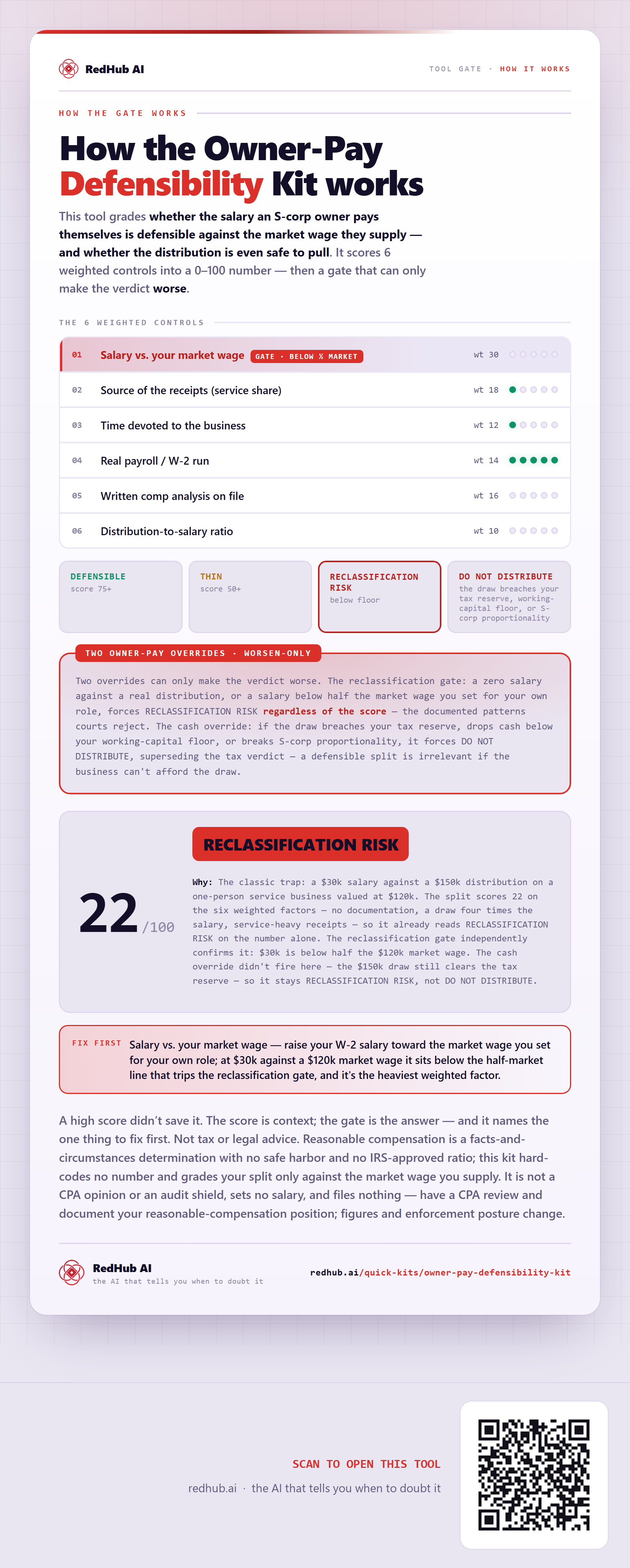
This tool grades whether the salary an S-corp owner pays themselves is defensible against the market wage they supply — and whether the distribution is even safe to pull. Each control is marked from your own evidence and weighted into a 0–100 score — and then the score is run past a gate that can only make the verdict worse.
The 6 weighted controls
| Signal | Weight |
|---|---|
| Salary vs. your market wage | 30 |
| Source of the receipts (service share) | 18 |
| Time devoted to the business | 12 |
| Real payroll / W-2 run | 14 |
| Written comp analysis on file | 16 |
| Distribution-to-salary ratio | 10 |
| Total | 100 |
The verdict bands
Two overrides can only make the verdict worse. The reclassification gate: a zero salary against a real distribution, or a salary below half the market wage you set for your own role, forces RECLASSIFICATION RISK regardless of the score — the documented patterns courts reject. The cash override: if the draw breaches your tax reserve, drops cash below your working-capital floor, or breaks S-corp proportionality, it forces DO NOT DISTRIBUTE, superseding the tax verdict — a defensible split is irrelevant if the business can't afford the draw.
In the worked sample it scores 22 out of 100 and still reads RECLASSIFICATION RISK — The classic trap: a $30k salary against a $150k distribution on a one-person service business valued at $120k. The split scores 22 on the six weighted factors — no documentation, a draw four times the salary, service-heavy receipts — so it already reads RECLASSIFICATION RISK on the number alone. The reclassification gate independently confirms it: $30k is below half the $120k market wage. The cash override didn't fire here — the $150k draw still clears the tax reserve — so it stays RECLASSIFICATION RISK, not DO NOT DISTRIBUTE. Marked fix first on this sample: Salary vs. your market wage — raise your W-2 salary toward the market wage you set for your own role; at $30k against a $120k market wage it sits below the half-market line that trips the reclassification gate, and it's the heaviest weighted factor..
Common questions
Can something score well on the How the Owner-Pay Defensibility Kit works and still fail?
Yes. The weighted score is run past a worsen-only gate — the Two owner-pay overrides — that can only make the verdict worse. In the worked sample it scores 22 out of 100 and still reads RECLASSIFICATION RISK, because the classic trap: a $30k salary against a $150k distribution on a one-person service business valued at $120k. The split scores 22 on the six weighted factors — no documentation, a draw four times the salary, service-heavy receipts — so it already reads RECLASSIFICATION RISK on the number alone. The reclassification gate independently confirms it: $30k is below half the $120k market wage. The cash override didn't fire here — the $150k draw still clears the tax reserve — so it stays RECLASSIFICATION RISK, not DO NOT DISTRIBUTE.
What is a worsen-only gate?
A dispositive rule that can only lower a verdict, never raise it. One fatal flaw overrides an otherwise-good score, because a single disqualifying gap shouldn't hide behind a high average. Where something is short, the fix-first row names it — here, "Salary vs. your market wage — raise your W-2 salary toward the market wage you set for your own role; at $30k against a $120k market wage it sits below the half-market line that trips the reclassification gate, and it's the heaviest weighted factor.".
Not tax or legal advice. Reasonable compensation is a facts-and-circumstances determination with no safe harbor and no IRS-approved ratio; this kit hard-codes no number and grades your split only against the market wage you supply. It is not a CPA opinion or an audit shield, sets no salary, and files nothing — have a CPA review and document your reasonable-compensation position; figures and enforcement posture change.
Embed this diagram
Free to share and embed with attribution (CC BY 4.0) — keep the link to redhub.ai.
Interactive — renders the live diagram
<iframe src="https://redhub.ai/visuals/tool/owner-pay-defensibility-kit.html" title="How the The Owner-Pay Defensibility Kit gate works — RedHub AI" width="760" height="2014" loading="lazy" style="border:0;width:100%;max-width:760px"></iframe>
<p style="font:14px/1.5 system-ui,sans-serif"><a href="https://redhub.ai/visuals/tool/owner-pay-defensibility-kit">How the The Owner-Pay Defensibility Kit gate works</a> — by <a href="https://redhub.ai">RedHub AI</a>, the AI that tells you when to doubt it.</p>
Image + link — a static picture for any blog
<a href="https://redhub.ai/visuals/tool/owner-pay-defensibility-kit"><img src="https://redhub.ai/visuals/tool/owner-pay-defensibility-kit-share.png" alt="Diagram of the Owner-Pay Defensibility Kit: pay-split factors scored to 0-100, a reclassification gate, and a cash override forcing DO NOT DISTRIBUTE." width="760" loading="lazy" style="max-width:100%;height:auto;border-radius:16px"></a>
<p style="font:14px/1.5 system-ui,sans-serif"><a href="https://redhub.ai">RedHub AI</a> — the AI that tells you when to doubt it.</p>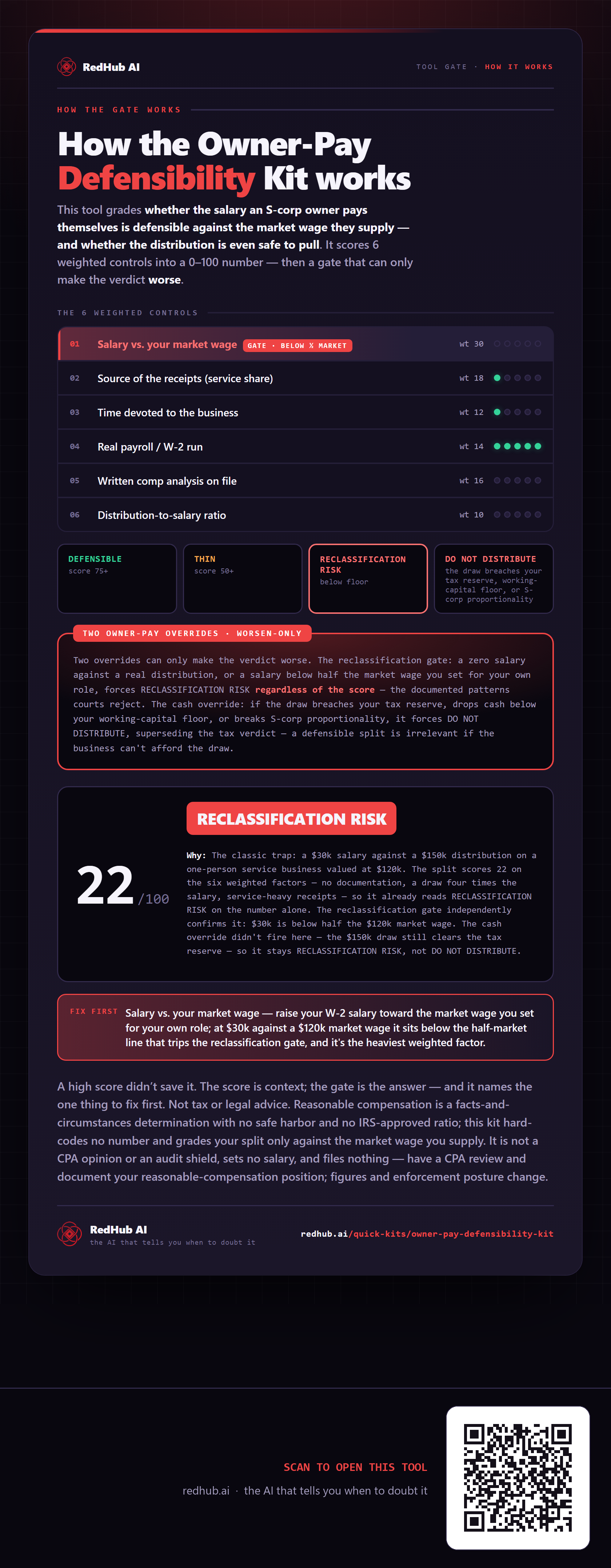
This is how The Owner-Pay Defensibility Kit works. More diagrams in the Visual Field Guide.