Support Deflection Honesty Grader
A deflection rate is the easiest support metric to inflate: a bot that makes people give up "deflects" them on paper. This grader splits the deflected bucket into genuine resolution versus hidden demand — and tells you the real rate you can actually defend.
REAL / SOFT / FALSE DEFLECTION per cohort, with a gate that calls a bot hiding demand what it is. It grades the metric claim from your own data — not people, and not a guaranteed rate.
one-time · instant download · yours to keep
The problem
A bot can "deflect" by making people give up.
Every interaction that doesn't reach an agent gets called 'deflected' — including the ones where the customer just quit in frustration.
Abandonment and repeat contacts don't show up in the headline rate. The demand didn't vanish; it moved to churn and bad reviews.
An inflated rate falls apart the first time someone asks 'and how many of those actually got resolved?' Better to know before they ask.
What's inside
One workbook. Three tabs. The real rate.
What each share means and how honesty, the real rate, and the gate work.
A row per cohort: claimed rate + the four-way split → honesty, real rate, hidden-demand share, verdict.
The REAL / SOFT / FALSE roll-up across every cohort, pulled live.
The standard
Three rules keep the rate honest.
Honesty is the genuinely-resolved share. Abandonment, repeat contacts, and escalations are hidden demand, not deflection.
An 80% claim that's 88% real is a 70% rate. That's the number you report — the one that survives a follow-up question.
If a third or more of the bucket is abandonment + repeat contact, it's FALSE DEFLECTION no matter how the rest looks.
A measurement aid that grades a metric claim from your own support data — not people. It applies no industry benchmark, is not a guaranteed rate, and is not financial advice.
How it works
Split the bucket. Watch the claim hold or collapse.
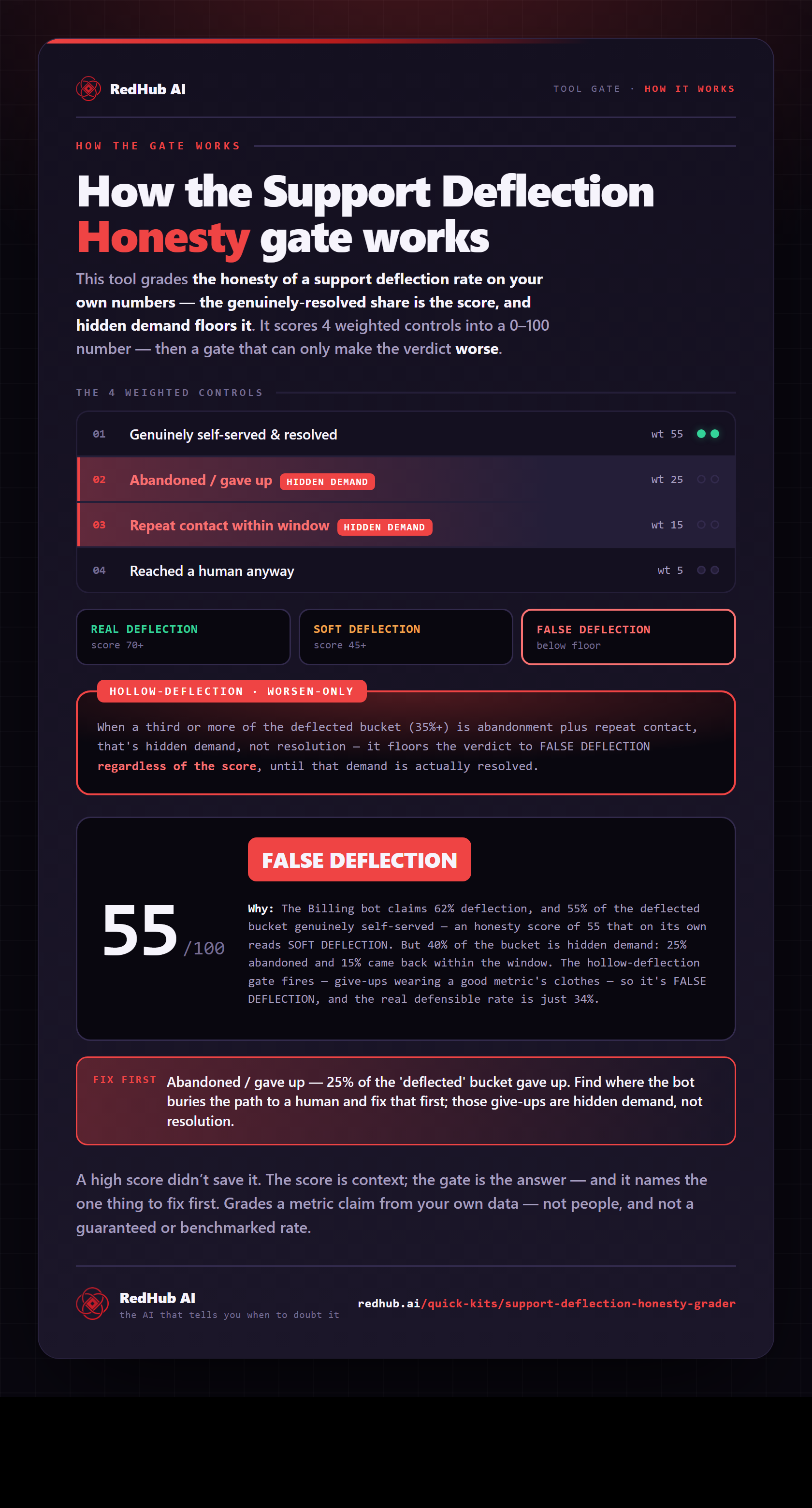
Hollow-deflection gate: 40% of the "deflected" bucket is abandonment + repeat contact. That's hidden demand, not resolution — FALSE DEFLECTION regardless of the headline rate.
Split the deflected bucket (must total 100%)
Same math as the workbook: honesty is the genuinely-resolved share, the real rate is claimed × honesty, and a gate forces FALSE DEFLECTION when a third or more of the bucket is abandonment and repeat contact — the way the example holds at FALSE even with honesty above the SOFT floor. It grades the claim, not people. Not a guaranteed rate.
This is the live engine. Grade every deflection cohort in one sheet Get the real rate you can actually defend Catch the bot that hides demand instead of resolving it
Get the kit — $49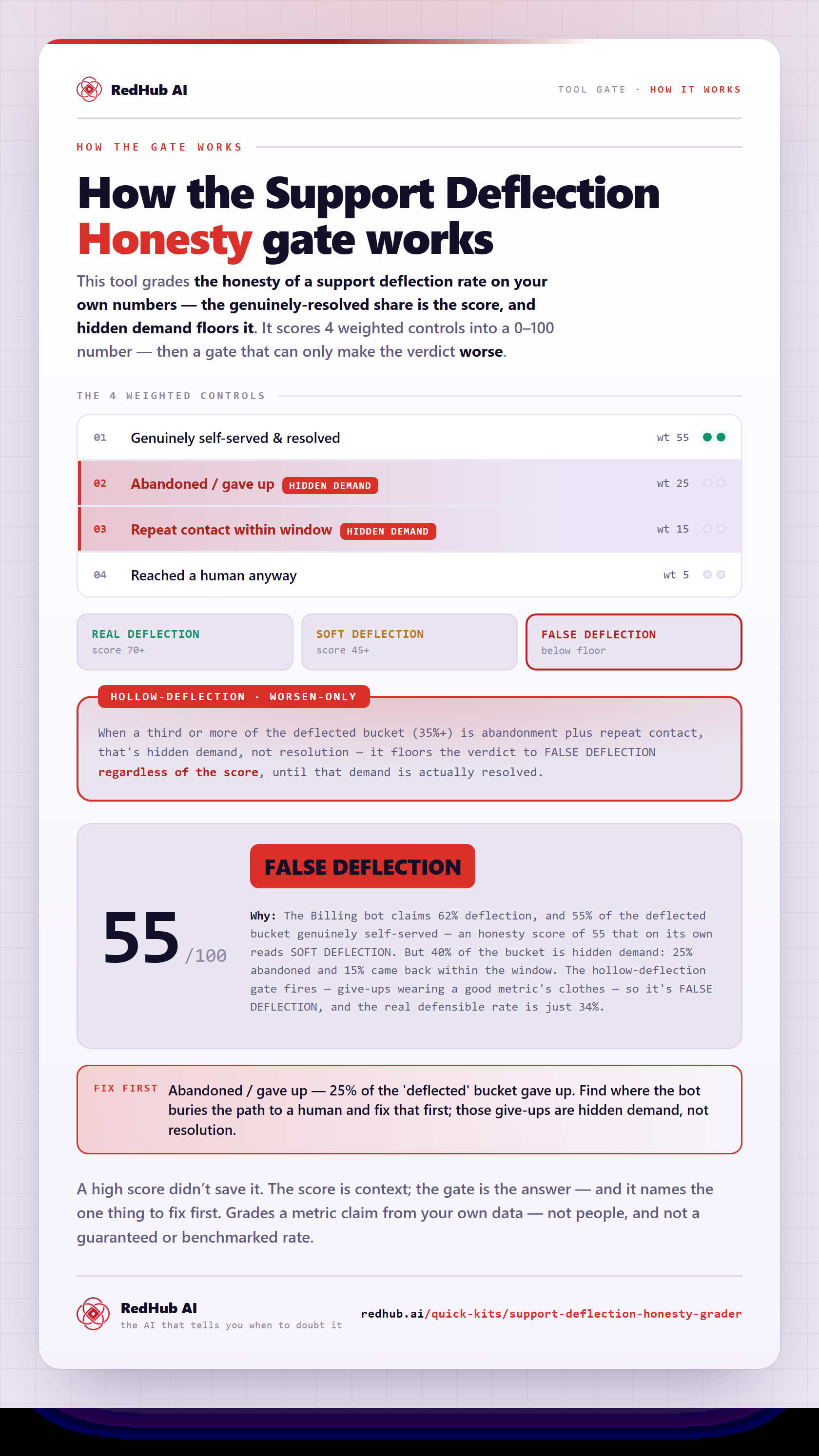
How the gate works, in one image
How the Support Deflection Honesty Grader scores a deflection rate on your own numbers and forces FALSE DEFLECTION when abandonment and repeat contact hide inside the deflected bucket — the same math the demo runs, as a diagram you can share or embed anywhere.
View & embed the full diagramWhat you'll see
The 62% claim that's really 34%.
Claimed 80%, and 88% of it genuinely self-served. The real, defensible rate is 70% — report that with confidence.
Claimed 62%, but 40% of the bucket is people abandoning or coming back. The gate calls it: that's hidden demand, not deflection. The honest rate is 34%, and the fix is to stop burying the path to a human.
Who it's for
For whoever has to stand behind the number.
- You report a deflection or containment rate to leadership.
- You're evaluating a support-bot vendor's claims.
- You want the rate you can defend, not just the headline.
- You want it to set up deflection (that's the Deflection Kit).
- You want a guaranteed or benchmarked rate — it uses your data only.
- You expect it to score agents or customers — it grades the metric.
Common Questions
Common questions.
The honesty of a support deflection (or containment) rate. For each cohort you enter the claimed rate plus how the deflected bucket actually split — genuinely self-served & resolved, abandoned, repeat contact, and reached-a-human-anyway (the four shares total 100%). It returns the genuinely-resolved share (honesty), the real defensible rate, the hidden-demand share, and a verdict: REAL / SOFT / FALSE DEFLECTION. It grades the metric claim from your own data — never people, and it's not a guaranteed or benchmarked rate.
Because "deflected" usually means "didn't reach an agent," which silently includes the people who just gave up. A bot can hit 60% deflection by burying the path to a human — but that demand didn't vanish, it moved to abandonment, repeat contacts, and churn. The headline rate looks great right up until someone asks how many of those actually got resolved. This splits the bucket so you know that before they ask.
Real deflection rate = claimed rate × the genuinely-resolved share. An 80% claim where 88% of the bucket truly self-served is a real rate of 70% — the number that survives a follow-up question. The kit computes it per cohort so you report the defensible figure instead of the inflated headline. In the worked example, a Billing bot's 62% claim is really 34%.
Because hidden demand is a veto. The hollow-deflection gate is dispositive: if a third or more of the deflected bucket (35%+) is abandonment plus repeat contact, the cohort is FALSE DEFLECTION no matter how the resolved share looks. The Billing bot has 55% resolved — above the FALSE floor on its own — yet gates to FALSE because 40% of its bucket is people abandoning or coming back. A deflection that mostly produces give-ups isn't resolution; it's hidden demand wearing a good metric's clothes.
Different jobs, and they pair. The AI Support Deflection Kit ($89) is the toolkit for building honest deflection — escalation rules, a playbook, KB templates, a CSAT tracker, a prompt pack. This grader is the measurement that audits whether a deflection rate you're already reporting is honest. Build it with the Kit, prove it's real with this. It's the same "do it / grade the result" split as the marketing line's measurement kit.
One .xlsx with three tabs — Start Here, Deflection Honesty (a row per cohort: claimed rate + the four-way split → honesty, real rate, hidden-demand share, verdict), and a Dashboard roll-up — that opens in Excel, Google Sheets, or Numbers. It's deterministic and offline, nothing uploaded. It applies no industry benchmark and isn't a guaranteed rate or financial advice; it just makes the number you report defensible.
Pairs well with
Build the honest-support stack.
The toolkit for building honest deflection — escalation rule, playbook, KB templates. This grades the result.
ViewSix Claude skills for the support surface — triage, replies, escalations, and more.
ViewThe same honest-metrics discipline, for marketing results you report.
ViewGet the grader
Report the rate that holds up.
- A per-cohort honesty score and real rate.
- A gate that catches a bot hiding demand.
- The number you can defend in the next QBR.
A measurement aid for a metric claim from your own data — not people, not a guaranteed rate, and not financial advice.
Sold by RedHub AI LLC · Secured by Stripe · redhub.ai