Tool Gate · How it works
How the Ontology Change-Impact Tripwire gate works
How the Ontology Change-Impact Tripwire grades every change in a schema release against what it breaks downstream and rolls up to the worst: a silent-break gate escalates a change that looks additive but never listed its consumers, so the release reads SILENT BREAKS PRESENT.
How the gate works
This tool grades every change in a schema / ontology release against what it breaks downstream, then rolls the release up to its worst change. It reads 7 changes and rolls them into one verdict — the worst, never the average — and then a gate that can only make it worse.
The 7 changes
| Change | Verdict |
|---|---|
| C-01 · invoice.state · add_enum_value | SILENT BREAKeverything still validates and runs, meaning moved · 6 named consumers |
| C-02 · project.status · add_enum_value | ADDITIVEdefault branch added everywhere · nothing downstream reads differently |
| C-03 · account.tier · add_enum_value | SILENT BREAKreads ADDITIVE on the answers, but the consumers were never listed |
| C-04 · supplier.tax_id · add_required_field | BREAKINGexisting records no longer validate · 9 named consumers |
| C-05 · employee.manager · widen_cardinalityfix first | SILENT BREAKmeaning moved, still validates · 12 named consumers |
| C-06 · Contractor · add_type | ADDITIVEnew entity type · nothing downstream reads differently |
| C-07 · order.legacy_code · remove_property | BREAKINGa downstream consumer stops running · 5 named consumers |
The verdict bands
A change that reads ADDITIVE on its three answers but whose consumers were never listed is escalated to SILENT BREAK — 'additive' is a claim about everyone who reads the field, and you can't make it about consumers you can't name. The release then takes its worst change: one silent break reads SILENT BREAKS PRESENT however high the additive share, and the gate can only ever escalate a quiet change, never soften a loud one.
In the worked sample it reads SILENT BREAKS PRESENT — Two of seven changes are additive and two are ordinary breaking changes — loud, expensive, and safe. But three are silent breaks: C-01 and C-05 move a field's meaning while everything still validates and runs, and C-03 reads ADDITIVE on its answers yet nobody could name its consumers, so the gate escalates it. One silent break overrides the 29% additive share, so the release reads SILENT BREAKS PRESENT. Marked fix first on this sample: C-05 — an employee may now have more than one manager: everything still validates and runs, but code reading the first manager silently drops the rest, and twelve named consumers sit behind it. Turn it into a loud break on purpose before it ships; then fix-first moves to C-01..
Common questions
Can every change look survivable on the How the Ontology Change-Impact Tripwire works and the company still read SILENT BREAKS PRESENT?
Yes. The roll-up takes the worst of 7 changes — never the average — then a worsen-only gate, the Silent-break gate gate, escalates when trouble clusters. In the worked sample it reads SILENT BREAKS PRESENT because two of seven changes are additive and two are ordinary breaking changes — loud, expensive, and safe. But three are silent breaks: C-01 and C-05 move a field's meaning while everything still validates and runs, and C-03 reads ADDITIVE on its answers yet nobody could name its consumers, so the gate escalates it. One silent break overrides the 29% additive share, so the release reads SILENT BREAKS PRESENT.
What is a worsen-only gate?
A dispositive rule that can only lower a verdict, never raise it. One fatal flaw overrides an otherwise-set of survivable lines, because a single disqualifying gap shouldn't hide behind an average of the healthy ones. Where something is short, the fix-first row names it — here, "C-05 — an employee may now have more than one manager: everything still validates and runs, but code reading the first manager silently drops the rest, and twelve named consumers sit behind it. Turn it into a loud break on purpose before it ships; then fix-first moves to C-01.".
Grades the changes you describe, never people. A working aid, not legal or compliance advice, and not an audit or a certification. ADDITIVE means your four answers said so, not that nothing downstream will notice.
Embed this diagram
Free to share and embed with attribution (CC BY 4.0) — keep the link to redhub.ai.
Interactive — renders the live diagram
<iframe src="https://redhub.ai/visuals/tool/ontology-change-impact-tripwire.html" title="How the Ontology Change-Impact Tripwire gate works — RedHub AI" width="760" height="2162" loading="lazy" style="border:0;width:100%;max-width:760px"></iframe>
<p style="font:14px/1.5 system-ui,sans-serif"><a href="https://redhub.ai/visuals/tool/ontology-change-impact-tripwire">How the Ontology Change-Impact Tripwire gate works</a> — by <a href="https://redhub.ai">RedHub AI</a>, the AI that tells you when to doubt it.</p>
Image + link — a static picture for any blog
<a href="https://redhub.ai/visuals/tool/ontology-change-impact-tripwire"><img src="https://redhub.ai/visuals/tool/ontology-change-impact-tripwire-share.png" alt="Diagram of the Ontology Change-Impact Tripwire: schema changes rolled up worst-not-average, a silent-break escalation gate, and the release reading SILENT BREAKS PRESENT." width="760" loading="lazy" style="max-width:100%;height:auto;border-radius:16px"></a>
<p style="font:14px/1.5 system-ui,sans-serif"><a href="https://redhub.ai">RedHub AI</a> — the AI that tells you when to doubt it.</p>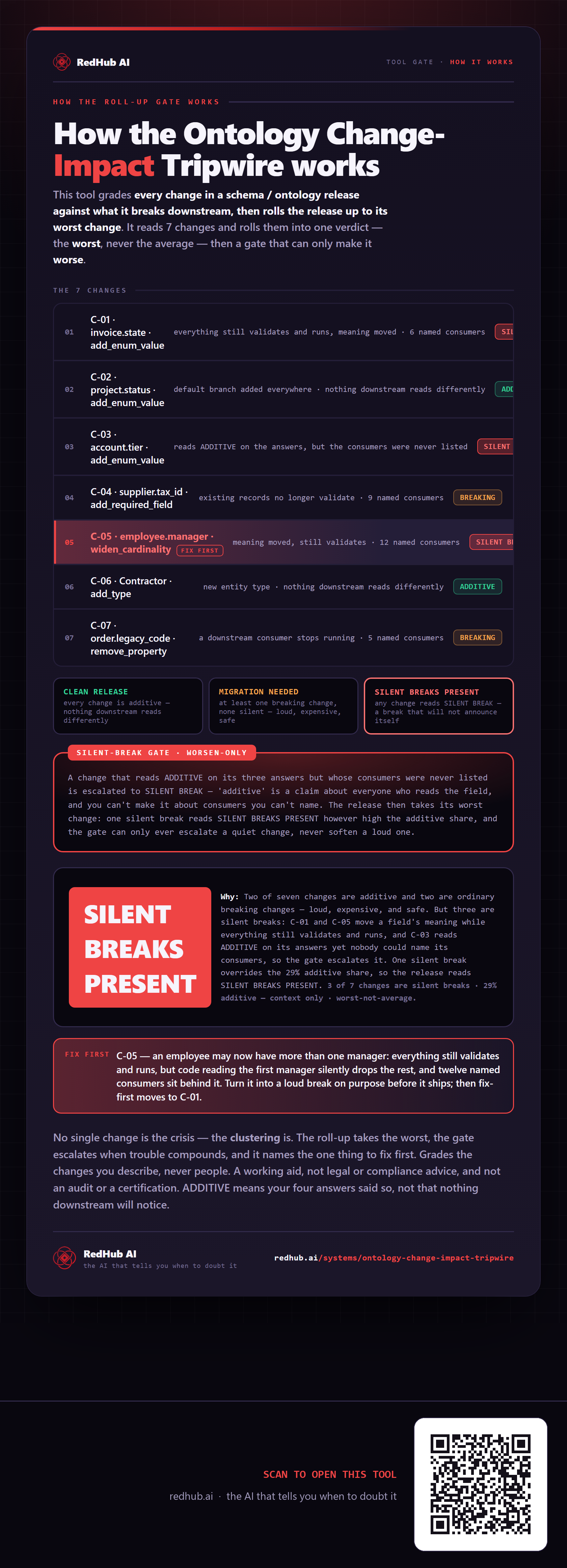
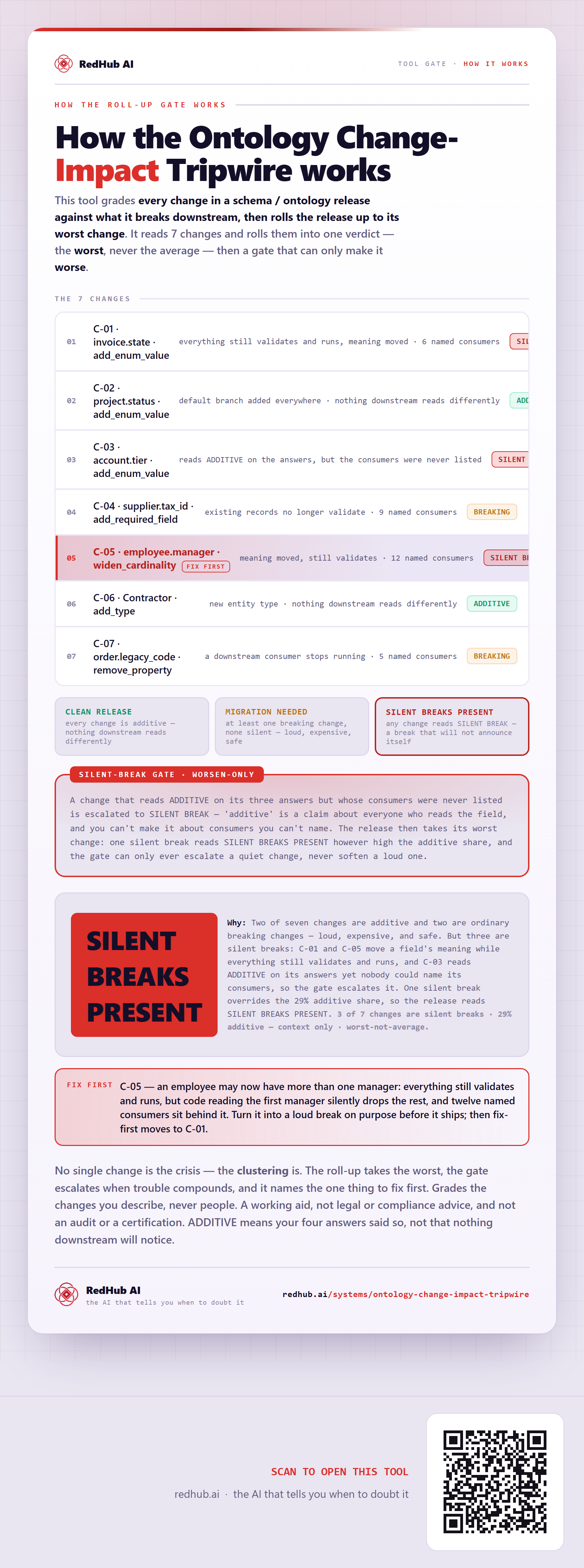
This is how Ontology Change-Impact Tripwire works. More diagrams in the Visual Field Guide.