

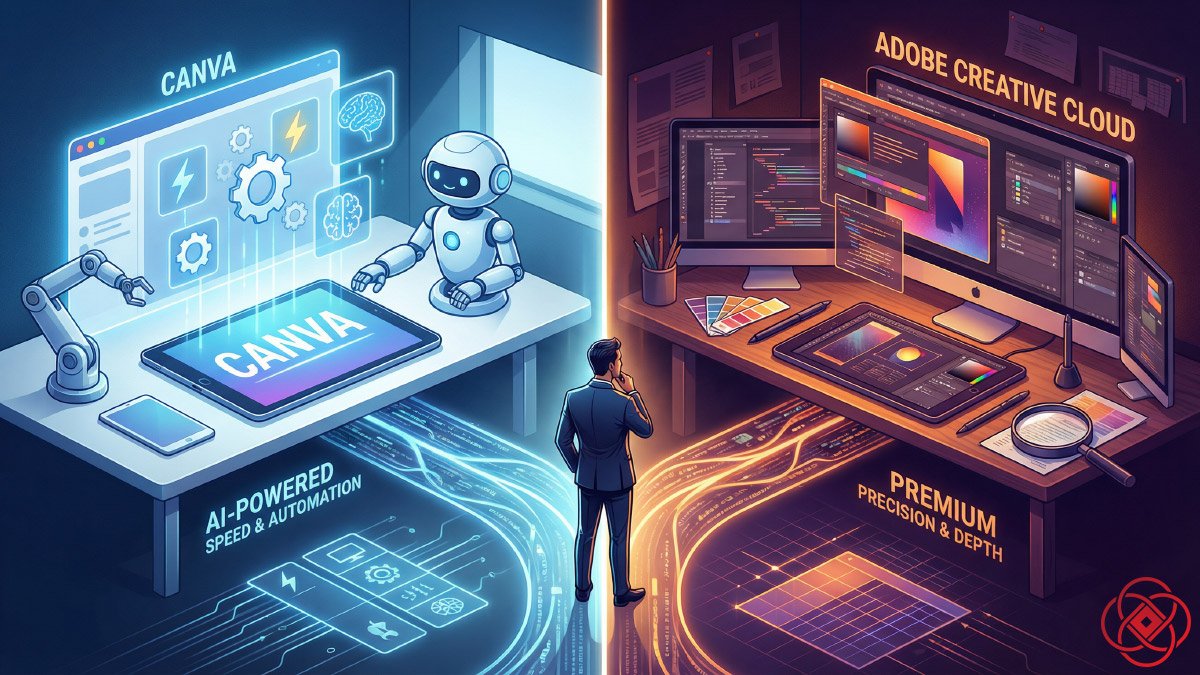
CANVA MAGIC STUDIO Part 3: Canva vs Adobe – The Decision Framework, the IPO Question, and the Future of AI Design
We’ve covered the tools, the enterprise features, and the market transformation. Now let’s address the strategic question that matters: Which tool should your business actually use?
This isn’t a simple answer. The right choice depends on your specific needs, team composition, budget, and content volume. Let’s build a decision framework.
YOUR COMPLETE DECISION MATRIX
CHOOSE CANVA + MAGIC STUDIO WHEN:
High-volume social content is your priority (5+ posts per week across multiple platforms)
Your team is creating dozens of graphics, posts, and marketing materials weekly. Speed and consistency matter more than perfection. Canva delivers 60–75% faster than traditional workflows with Magic Studio automation.
Your team has limited design experience
Not everyone needs to be (or can be) a trained graphic designer. Canva’s intuitive interface lets non-designers produce professional results. Magic Design and Magic Write eliminate blank page paralysis.
Budget is a significant constraint (<$100/month)
Canva Pro: $12.99/month
Adobe Creative Cloud: $69.99/month per user
Canva Teams: $14.99/month per user
The cost math is brutal for budget-conscious organizations.
You need integrated social scheduling
Canva’s Content Planner lets you design and schedule in one workflow—no external tools required.
Your team is 1–25 people without a dedicated designer
This is Canva’s sweet spot. Too large for one person. Too small for a full-time designer. Canva enables non-designers to be ~80% as effective for most content.
Brand consistency at the SMB level is sufficient
You have brand guidelines, but not enterprise-grade enforcement needs. Canva Brand Kits (Pro+) are adequate for dozens—not hundreds—of users.
CHOOSE ADOBE + FIREFLY WHEN:
Professional image quality is non-negotiable
Your brand depends on premium visuals. Adobe Firefly produces higher-quality, anatomically accurate imagery than Canva’s Dream Lab. For flagship campaigns, Adobe wins.
Your team includes trained designers
Designers fluent in Photoshop, Illustrator, and InDesign are faster in Adobe. Forcing Canva would be downskilling.
Your organization has strict visual standards
You need pixel-perfect brand governance across hundreds of creators. Adobe’s compliance controls still outperform Canva.
Print production and advanced editing are core
Packaging, large-format printing, publication design, pre-press workflows—this is Adobe territory.
You’re already embedded in Creative Cloud
Migration costs—technical and psychological—matter. Adding Firefly is easier than switching platforms.
Advanced photo editing and color grading matter
Layer masks, adjustment layers, blend modes—Photoshop still has no Canva equivalent.
USE BOTH WHEN:
You have mixed content creation needs
- Canva → social, email, presentations, routine marketing
- Adobe → hero images, print, complex effects, flagship campaigns
Your team includes designers and non-designers
This is optimal resource allocation, not inefficiency.
Your budget supports dual toolsets (~$80–150/month)
- Canva Enterprise: ~$2,000–30,000 annually
- Adobe Creative Cloud: ~$840/user/year
Most mid-sized organizations (50–500 people) land here.
You have specialized roles
Marketing = Canva
Design = Adobe
Creative Ops = workflow orchestration
THE REAL ECONOMICS: TOTAL COST OF OWNERSHIP
SCENARIO 1: SOLO CONTENT CREATOR
- Canva Pro: $155.88/year
- Adobe: $839.88/year
- Savings: $684/year
Result: Canva wins unless you’re doing professional-grade design.
SCENARIO 2: SMALL TEAM (5 creators + 1 designer)
- Hybrid cost: $1,739/year
- All Adobe: $5,039/year
Result: $3,300/year saved with better tool alignment.
SCENARIO 3: ENTERPRISE (200 users)
- Hybrid: ~$25,000–40,000/year
- All Adobe: ~$168,000/year
Result: $125,000+ annual savings with quality intact.
THE IPO QUESTION: WHAT’S COMING IN 2026
Canva is preparing for an IPO.
Valuation: $42B (Aug 2025), up from $32B in 10 months.
Expect:
- Pricing increases
- Aggressive AI expansion
- Acquisitions
- International growth
If your business depends on Canva, lock in annual pricing now.
THE FUTURE OF AI IN DESIGN
The real disruption isn’t Canva vs Adobe.
It’s: “Do humans need to design at all?”
WHAT’S COMING
- Context-aware AI design
- Generative design systems
- Video-to-design automation
- Multimodal AI (text, image, video, voice)
- Copyright indemnification
- Hyper-personalization at scale
WHAT THIS MEANS
In 3–5 years, execution is automated.
Humans shift to creative direction, strategy, and AI training.
Organizations gain:
- Lower design labor costs
- Faster time-to-market
- Unprecedented personalization
THE HYBRID REALITY: BEST PRACTICE IN 2025
80% Canva (speed + scale)
20% Adobe (premium elevation)
This delivers the optimal quality-to-cost ratio.
THE STRATEGIC QUESTIONS TO ASK
- Volume vs premium content?
- Speed, quality, or consistency bottleneck?
- Budget range?
- Design team or non-designers?
- Growth trajectory?
THE BOTTOM LINE
Canva didn’t beat Adobe.
They expanded the market.
Adobe = professional design
Canva = everyone else
The winners will be tool-agnostic, AI-native, and workflow-driven.
YOUR NEXT STEPS
- Templates → Canva Pro
- Outsourcing → model Canva ROI
- Adobe shops → test Canva for 80%
- Content businesses → lock pricing pre-IPO
- Enterprise → hybrid workflows
The design revolution isn’t coming. It’s already here.