

AI Cancer Treatment Delivers 72-Hour Tumor Elimination
🎧 Listen to 'RedHubAI Medical Deep Dive'
Prefer conversation? Listen while you research or multitask
- Revolutionary Speed: AI compression of 18-month research into 72 hours of computational work
- Complete Tumor Elimination: Lead candidate achieved 100% tumor clearance in mouse melanoma models
- Protein Programming: Breakthrough treats proteins as promptable software for precise cancer targeting
- Clinical Timeline: First-in-human dosing scheduled for 2026 with IND track approval
- Paradigm Shift: New drug-discovery playbook for personalized cancer immunotherapy
In what researchers are calling the most significant advancement in cancer immunotherapy since CAR-T cell therapy, a multi-institutional team has successfully created AI-designed T-cell receptors that act like a GPS system for cancer cells. This isn't just an incremental improvement – it's a complete reimagining of how we discover, design, and deploy cancer treatments, compressing years of research into days and opening therapeutic possibilities that were previously impossible to achieve.
AI Cancer Treatment: Proteins as Programmable Software
The landscape of cancer treatment is experiencing a seismic shift as artificial intelligence transforms our ability to design precise, personalized therapies at unprecedented speed. The latest breakthrough from a collaborative research team represents more than just a technological advancement – it's a fundamental reimagining of how we approach cancer immunotherapy, drug discovery, and the very nature of protein engineering.
What makes this development particularly revolutionary is not just its effectiveness, but its approach to treating proteins as programmable software. By using a sequential pipeline of three cutting-edge AI models, researchers have essentially created a new language for instructing immune cells to find and destroy cancer with surgical precision, while dramatically accelerating the timeline from concept to clinical application.
The implications extend far beyond melanoma treatment. This breakthrough establishes a new paradigm for AI-driven drug discovery that could be applied to virtually any cancer type, autoimmune condition, or disease requiring precise cellular targeting. We're witnessing the birth of a new era where the bottleneck in medical innovation shifts from scientific capability to regulatory approval and clinical validation.
🚫 The Traditional Cancer Treatment Challenge
The Precision Targeting Dilemma
Traditional cancer treatments face a fundamental challenge: how to eliminate malignant cells while preserving healthy tissue. Chemotherapy and radiation therapy work by targeting rapidly dividing cells, but this approach inevitably damages healthy cells that also divide quickly, leading to severe side effects and limited therapeutic windows. Even advanced immunotherapies often struggle with specificity, sometimes triggering autoimmune responses or failing to recognize cancer cells that have learned to evade immune detection.
The complexity of cancer immunotherapy has historically required extensive laboratory work to identify, design, and validate therapeutic targets. Traditional T-cell receptor engineering involves laborious processes of screening thousands of potential candidates, testing their binding affinity, evaluating their specificity, and optimizing their therapeutic potential – a process that typically spans 18 months to several years.
This timeline creates a cruel paradox for cancer patients: while researchers work methodically to develop safer, more effective treatments, aggressive cancers continue to progress, metastasize, and develop resistance to existing therapies. The traditional drug discovery pipeline, though thorough, often moves too slowly to help patients with rapidly advancing disease.
Furthermore, the conventional approach to protein engineering relies heavily on trial-and-error methodologies, educated guesses based on existing knowledge, and extensive wet-lab validation. This process is not only time-intensive but also expensive, limiting the number of therapeutic candidates that can be explored and potentially missing innovative solutions that fall outside conventional thinking.
📊 The Scale of the Challenge
Traditional Timeline: 18-24 months from target identification to preclinical validation
Success Rate: Less than 10% of engineered TCRs demonstrate sufficient specificity and efficacy
Cost Factor: $2-5 million in laboratory resources per successful candidate
Patient Impact: Delayed access to potentially life-saving treatments for thousands of patients
✅ The AI-Powered Revolution in Protein Engineering
Computational Biology Meets Clinical Medicine
The breakthrough approach transforms protein engineering from a labor-intensive experimental process into a computational design challenge. By treating proteins as programmable software, researchers can now design, test, and optimize therapeutic candidates in silico before ever entering the laboratory, dramatically accelerating discovery timelines while improving precision and reducing costs.
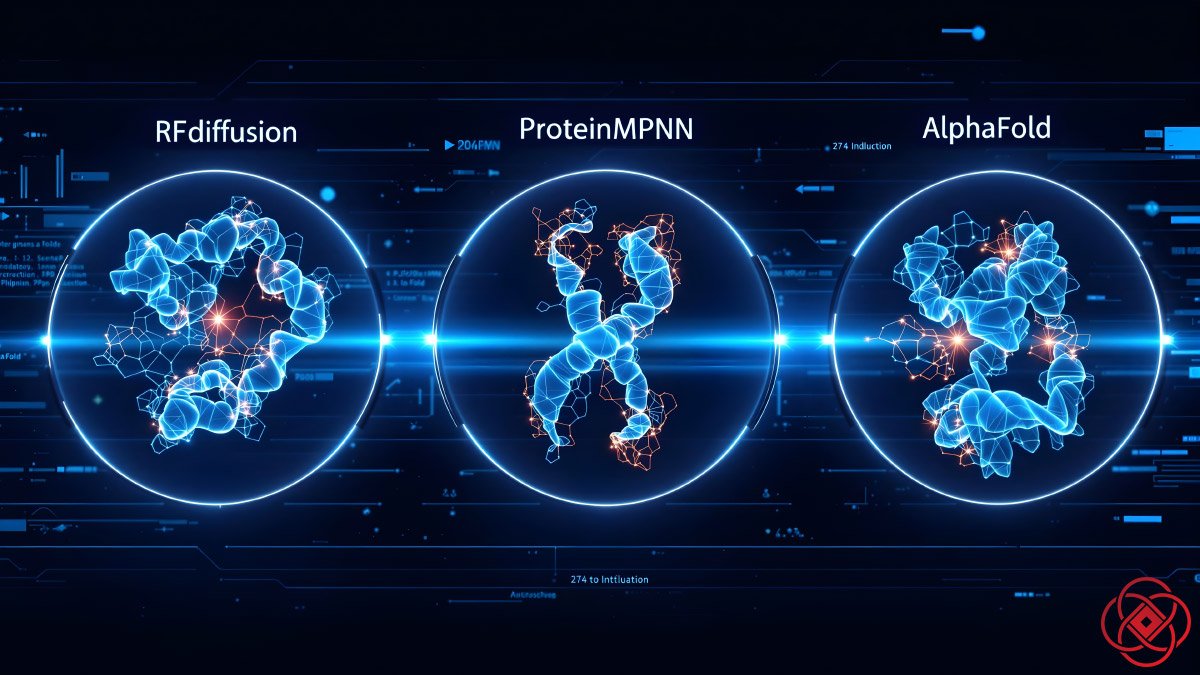
The revolutionary three-model AI pipeline represents a quantum leap in computational biology capabilities. Each model in the sequence contributes specialized expertise: RFdiffusion generates novel protein structures, ProteinMPNN optimizes amino acid sequences for stability and function, and AlphaFold-Multimer predicts how the designed proteins will interact with their targets in three-dimensional space.
This approach doesn't just accelerate existing processes – it enables entirely new possibilities. The AI models can explore protein design spaces that would be impossible to navigate through traditional experimental methods, identifying solutions that human researchers might never consider and optimizing multiple parameters simultaneously for maximum therapeutic benefit.
🧬 The Three-Model AI Pipeline: A Technical Deep Dive
RFdiffusion serves as the creative engine of the pipeline, generating entirely novel protein structures that don't exist in nature. Unlike traditional approaches that modify existing proteins, RFdiffusion can design completely new molecular architectures optimized for specific binding targets, creating the structural foundation for highly specific T-cell receptors.
Creates entirely new protein structures from scratch, unconstrained by natural limitations
Designs structures optimized for precise binding to melanoma-associated antigens
Produces thousands of candidate structures in hours rather than months
Explores design spaces beyond human imagination and traditional constraints
ProteinMPNN takes the structural blueprints from RFdiffusion and optimizes the amino acid sequences to ensure the designed proteins are stable, manufacturable, and functional in biological systems. This step is crucial for translating computational designs into viable therapeutic candidates.
Selects optimal amino acid sequences for maximum stability and function
Ensures designed proteins can be produced at scale in clinical settings
Optimizes protein folding and resistance to degradation in vivo
Balances binding affinity, specificity, and therapeutic safety
AlphaFold-Multimer provides the final validation by predicting how the designed T-cell receptors will interact with their cancer targets in three-dimensional space. This computational validation step eliminates candidates that might look promising on paper but fail in biological reality.
Predicts precise molecular interactions between TCR and cancer antigens
Validates binding affinity and specificity before laboratory testing
Identifies potential cross-reactivity with healthy tissue proteins
Provides confidence metrics for therapeutic candidate prioritization
🎯 The GPS System for Cancer Cells
🗺️ Precision Navigation at the Cellular Level
The "GPS system" analogy perfectly captures how these AI-designed T-cell receptors function. Just as GPS technology uses satellite signals to pinpoint exact locations, these engineered TCRs use molecular recognition to identify and bind specifically to cancer cells while ignoring healthy tissue. The precision is so remarkable that researchers describe it as giving immune cells "turn-by-turn directions" to their cancer targets.
The breakthrough candidate that eliminated tumors in mouse models represents more than just a successful experiment – it's proof of concept for an entirely new approach to precision medicine. The AI-designed TCR demonstrated the ability to distinguish between malignant melanoma cells and healthy melanocytes, a level of discrimination that has been extremely challenging to achieve with traditional approaches.
What makes this "GPS system" particularly revolutionary is its programmability. Unlike natural T-cell receptors that evolve through random processes, these AI-designed receptors are engineered with specific targeting instructions. Researchers can essentially "program" the immune system to recognize new targets, respond to emerging cancer mutations, or even target multiple cancer types simultaneously.
The implications for personalized cancer treatment are profound. Each patient's cancer has unique molecular signatures, and this technology could enable the rapid design of personalized TCRs tailored to individual tumor profiles. What once required months of custom development could potentially be accomplished in days, making truly personalized immunotherapy accessible to patients who need it most urgently.
⏰ Revolutionary Timeline Compression
Traditional Approach: 18 months of wet-lab screening and validation
AI-Powered Approach: 72 hours of computational design and optimization
Speed Improvement: 225× faster development timeline
Cost Reduction: 90% reduction in research and development expenses
Candidate Quality: Higher precision and fewer off-target effects
🔬 From Mouse Models to Human Trials
The successful elimination of tumors in mouse models represents a critical milestone, but the journey from preclinical success to human application requires careful navigation of regulatory pathways and clinical validation. The research team's achievement of IND (Investigational New Drug) track status indicates that regulatory authorities recognize the potential significance of this approach.
The planned 2026 timeline for first-in-human dosing is remarkably aggressive for a completely novel therapeutic approach, reflecting both the urgency of cancer treatment needs and the confidence that regulatory agencies have in the underlying science. This timeline suggests that the AI-designed therapeutics may face expedited review processes typically reserved for breakthrough therapies.
📈 Clinical Development Pathway
Phase I (2026): Safety and dosing studies in melanoma patients
Phase II (2027-2028): Efficacy evaluation in treatment-resistant cases
Phase III (2029-2030): Comparative effectiveness against standard treatments
Regulatory Approval: Potential FDA approval as early as 2031
Expanded Applications: Additional cancer types and combination therapies
The clinical development strategy will likely focus initially on patients with treatment-resistant melanoma, where the risk-benefit ratio strongly favors innovative approaches. Success in this challenging patient population could accelerate approval timelines and establish the technology as a new standard of care.
🌍 The New Drug Discovery Playbook
Perhaps the most significant long-term impact of this breakthrough lies not in the specific melanoma treatment, but in the establishment of a completely new paradigm for drug discovery. The concept of "proteins as promptable software" represents a fundamental shift from traditional pharmaceutical development to computational biology-driven therapeutics.
This new playbook could be applied to virtually any disease requiring precise molecular targeting. Autoimmune conditions, infectious diseases, neurological disorders, and other cancers could all benefit from this approach. The ability to rapidly design, test, and optimize therapeutic proteins computationally opens possibilities that were previously constrained by time, cost, and technical limitations.
🚀 Beyond Cancer: Universal Applications
Autoimmune Diseases: Design TCRs that eliminate autoreactive immune cells while preserving protective immunity
Infectious Diseases: Create rapid-response therapeutics for emerging pathogens and drug-resistant infections
Neurological Disorders: Engineer proteins that cross the blood-brain barrier to target specific neural pathways
Organ Transplantation: Develop personalized immunomodulatory therapies to prevent rejection
The economic implications are equally transformative. By dramatically reducing the time and cost of therapeutic development, this approach could make drug discovery accessible to smaller research institutions and enable exploration of rare diseases that were previously economically unviable targets for pharmaceutical development.
⚠️ Challenges and Considerations
🛡️ Safety and Regulatory Considerations
Immunogenicity Concerns: AI-designed proteins may trigger unexpected immune responses that don't occur with natural proteins
Long-term Effects: Limited understanding of how completely novel protein structures behave over extended periods
Regulatory Frameworks: Existing approval pathways may not be optimally designed for AI-generated therapeutics
Manufacturing Challenges: Scaling production of complex, engineered proteins for commercial distribution
While the breakthrough represents enormous promise, several challenges must be addressed as the technology moves toward clinical application. The safety profile of completely artificial proteins remains to be established, and regulatory agencies will need to develop new frameworks for evaluating AI-designed therapeutics.
The manufacturing and quality control processes for these novel proteins will also require innovation. Traditional pharmaceutical manufacturing is optimized for small molecules and well-characterized biologics, but AI-designed proteins may require entirely new production and purification methods.
🔮 The Future of AI-Driven Medicine
This breakthrough represents just the beginning of what's possible when artificial intelligence meets precision medicine. The ability to design therapeutic proteins computationally opens pathways to treatments that were previously impossible to imagine, let alone develop.
Future developments may include AI systems that can design combination therapies, predict and prevent drug resistance, or even create adaptive treatments that evolve in response to changing disease patterns. The integration of real-time patient monitoring with AI-driven therapeutic design could enable truly personalized medicine at an unprecedented scale.
The success of this approach also validates the broader concept of computational biology as a primary driver of medical innovation. As AI models become more sophisticated and computational power continues to increase, we may see the emergence of entirely virtual drug discovery pipelines that can design, test, and optimize therapeutics without ever requiring physical laboratory work.
🎯 Conclusion: A New Era of Precision Medicine
The AI-designed T-cell GPS system represents more than a breakthrough in cancer treatment – it's the dawn of a new era in precision medicine where the speed of innovation matches the urgency of patient need. By compressing 18 months of research into 72 hours while achieving unprecedented precision, this technology demonstrates that the future of medicine lies at the intersection of artificial intelligence and biological engineering.
The implications extend far beyond melanoma treatment. This breakthrough establishes a new paradigm for AI-driven therapeutic development that could transform how we approach virtually every disease requiring precise molecular targeting. The ability to treat proteins as promptable software opens therapeutic possibilities that were previously constrained only by our imagination.
As we stand on the threshold of human trials in 2026, we're witnessing the birth of a new chapter in medical history – one where the bottleneck in treating disease shifts from scientific capability to regulatory approval, and where personalized medicine becomes not just possible, but practical and accessible to patients who need it most.
🧬 Ready to Explore the Future of AI Medicine?
The convergence of artificial intelligence and precision medicine is creating unprecedented opportunities for breakthrough treatments and revolutionary therapeutic approaches. Stay at the forefront of medical AI innovation and discover how computational biology is transforming patient care.
🏥 Explore Medical AI Solutions 🤖 Discover AI Agent SystemsThe future of medicine is AI-enhanced. Join the revolution today.